
Illustrative application image. This image is not evidence of a customer installation or a validated spring assembly.
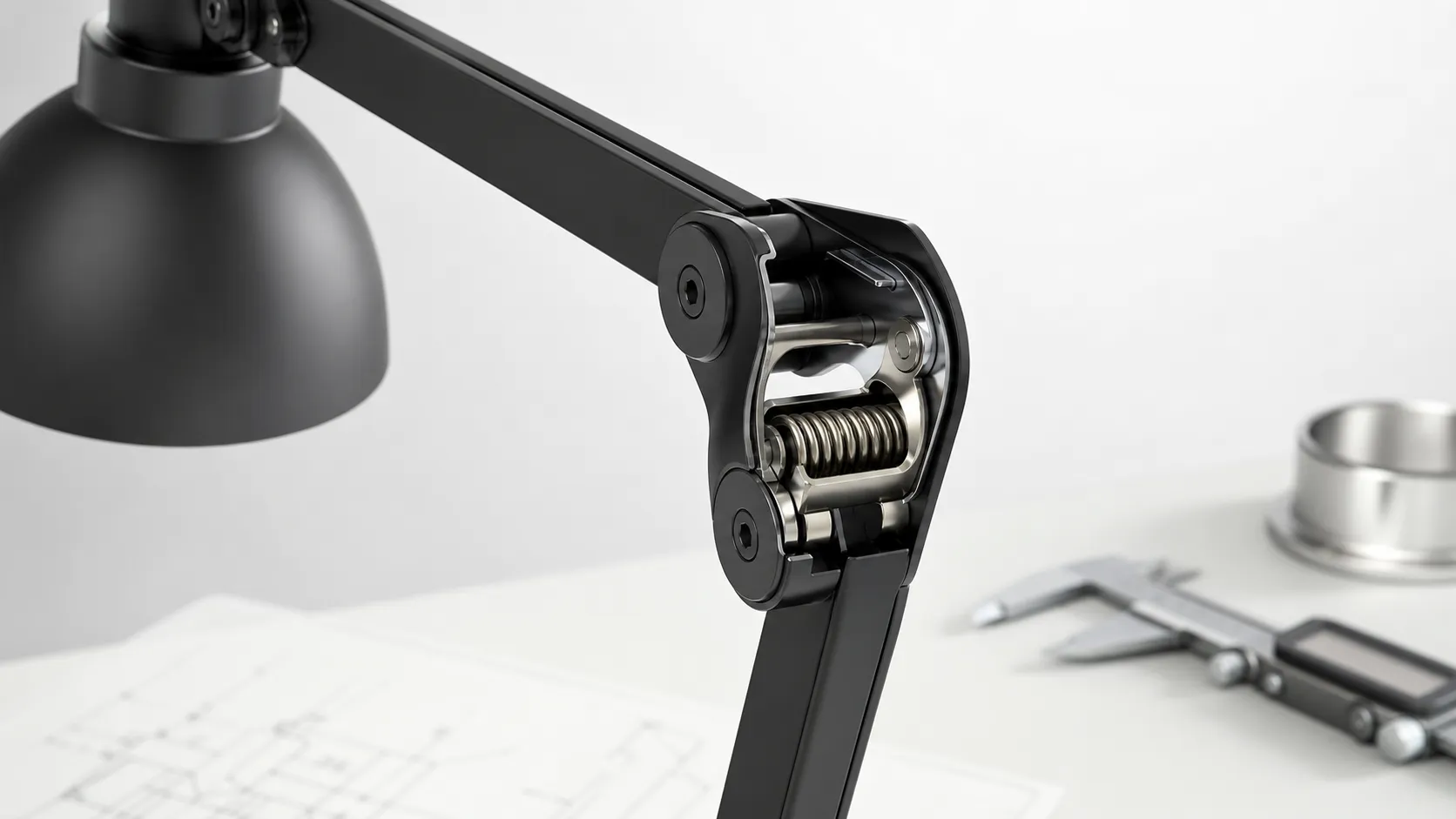
Constant torque springs can help adjustable lighting fixtures and task lamps move smoothly, hold position, and provide controlled rotary support in compact hinge mechanisms. They are useful when a lamp arm, cover, or rotating part must feel stable across repeated adjustment angles.
A constant torque spring provides relatively stable torque over its working rotation. For lighting products, this can improve user feel and reduce sudden drop, drift, or uneven adjustment.
Quick answer: when is a constant torque spring useful in lighting design?
It is useful when a lighting arm or hinge needs stable torque through a range of rotation. The spring can help balance part of the lamp head weight and support repeated angle adjustment.
Common applications
- Adjustable task lamps
- Reading lights and inspection lights
- Rotary covers for lighting modules
- Foldable lamp arms
- Display or workstation lighting hinges
Design inputs
| Input | Design impact |
|---|---|
| Lamp head weight | Determines torque support requirement. |
| Rotation angle | Defines the spring working range. |
| Hinge diameter | Affects available spring size and installation layout. |
| User feel | Controls whether movement feels smooth, firm, or light. |
| Cycle life | Important for products adjusted frequently. |
Why torque consistency matters
If torque is too low, the lamp head may fall or drift. If torque is too high, adjustment may feel stiff. A good design balances spring torque, hinge friction, lamp weight, and the expected user operation.
Prototype testing
Testing should include opening angle, holding force, noise, repeated adjustment, hinge wear, assembly tolerance, and temperature conditions. The spring should be evaluated in the complete hinge assembly, not only as a separate part.
Custom spring manufacturing
Shenzhen Leading Spring supports custom torque spring development for adjustable lighting fixtures, hinge arms, rotary covers, and compact positioning structures. Contact Shenzhen Leading Spring for technical review.
FAQ
Can constant torque springs hold a lamp arm in position?
They can help support position, but hinge friction and mechanical stops should also be considered.
What affects lamp hinge torque?
Lamp head weight, arm length, rotation angle, hinge friction, spring size, and installation layout all affect torque.
Can torque be customized for different lamp models?
Yes. Torque can be customized according to product weight, hinge size, working angle, and user feel requirements.