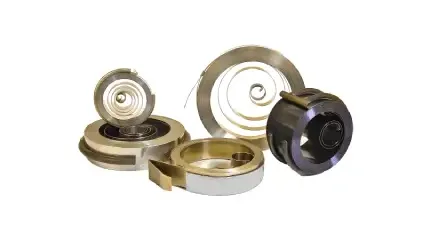
Power Springs
Rotational Energy for Custom Return Mechanisms
How Power Springs Work
Power springs work or function by tightly winding a strip of spring-tempered material onto an arbor housed within a circular case (keeper). When wound, the spring stores mechanical energy and releases it as torque when unwound.
As the spring unwinds, it expands toward the keeper’s maximum allowed curvature, delivering rotational force to the free-rotating portion of the assembly. The spring supplies return torque; speed control and stopping behavior also depend on the load, transmission and other components in the assembly.
However, the torque-deflection characteristics of a power spring are nonlinear. This is due to:
◉ Changing amounts of active material during operation
◉ Inter-coil friction
◉ Hysteresis effects within the assembly
Design Guidelines for Optimal Performance
Performance depends on the complete spring and housing design:
◉ Agree strip material, thickness, width and length with the spring drawing.
◉ Check arbor diameter, case diameter, clearance and permitted working turns together.
◉ Define preload, winding direction and torque limits at specified angles.
Pre-stressing changes the spring configuration and must be assessed for the required torque curve and cycle life. Avoid treating a single geometric ratio or turn count as a universal design limit; verify the intended assembly with samples.
Understanding the torque curve of a power spring is key to precision design. This curve highlights the spring’s torque output over its deflection range, providing a basis for comparing the required torque at specified working angles.
Power Spring Applications:
Whether your application requires rotational energy or linear motion (using a pulley or cable system), review the spring output and the surrounding assembly together.
Potential application areas are listed below for discussion. They are not evidence of Leading Spring customer installations or qualification for a particular device.
Medical Devices
◉ Mechanical assemblies
◉ Compact motion systems
Industrial
◉ Counterbalances
◉ Cord retractors
◉ Wind-up devices
◉ Timers and escapements
Aerospace & Defense
◉ Electrical/mechanical reels
◉ Static discharge reels
Commercial
◉ Wind-up toys
◉ Timers
◉ Cord and cable reels
Power Springs (Clock Springs) – Precision-Engineered
Power springs, also known as clock springs, store rotational energy in a compact housing. Material and strip dimensions are selected for the required torque, working turns, available space and duty conditions. Confirm proposed dimensions, tolerances and manufacturing feasibility with the supplier before approving the spring drawing.
Need a Custom Power Spring?
We have been delivering precision spring solutions for many years. Contact our engineering department today to discuss how we can help you optimize your power spring design for performance, efficiency, and durability.
Prepare a Power Spring Application Review
Describe the return or retraction task, project stage and the behavior you need to improve. A non-confidential sketch can show the shaft or reel, direction of rotation and available housing space. If a cable is involved, describe its path and how the effective winding radius changes.
For detailed selection, define torque at specified angles, working rotation, preload, mounting constraints and operating conditions. Keep confidential dimensions and drawings for an agreed private channel.
Agree the sample checks before evaluating a proposed revision: torque output, completion of return, speed and stopping behavior are separate questions. Confirm relevant durability conditions and acceptance limits for the complete mechanism. Quantities, timing and available documentation are confirmed for the individual project.
Read the return overspeed guide or prepare a focused video brief, then discuss your power spring application.