
Illustrative application image. This image is not evidence of a customer installation or a validated spring assembly.
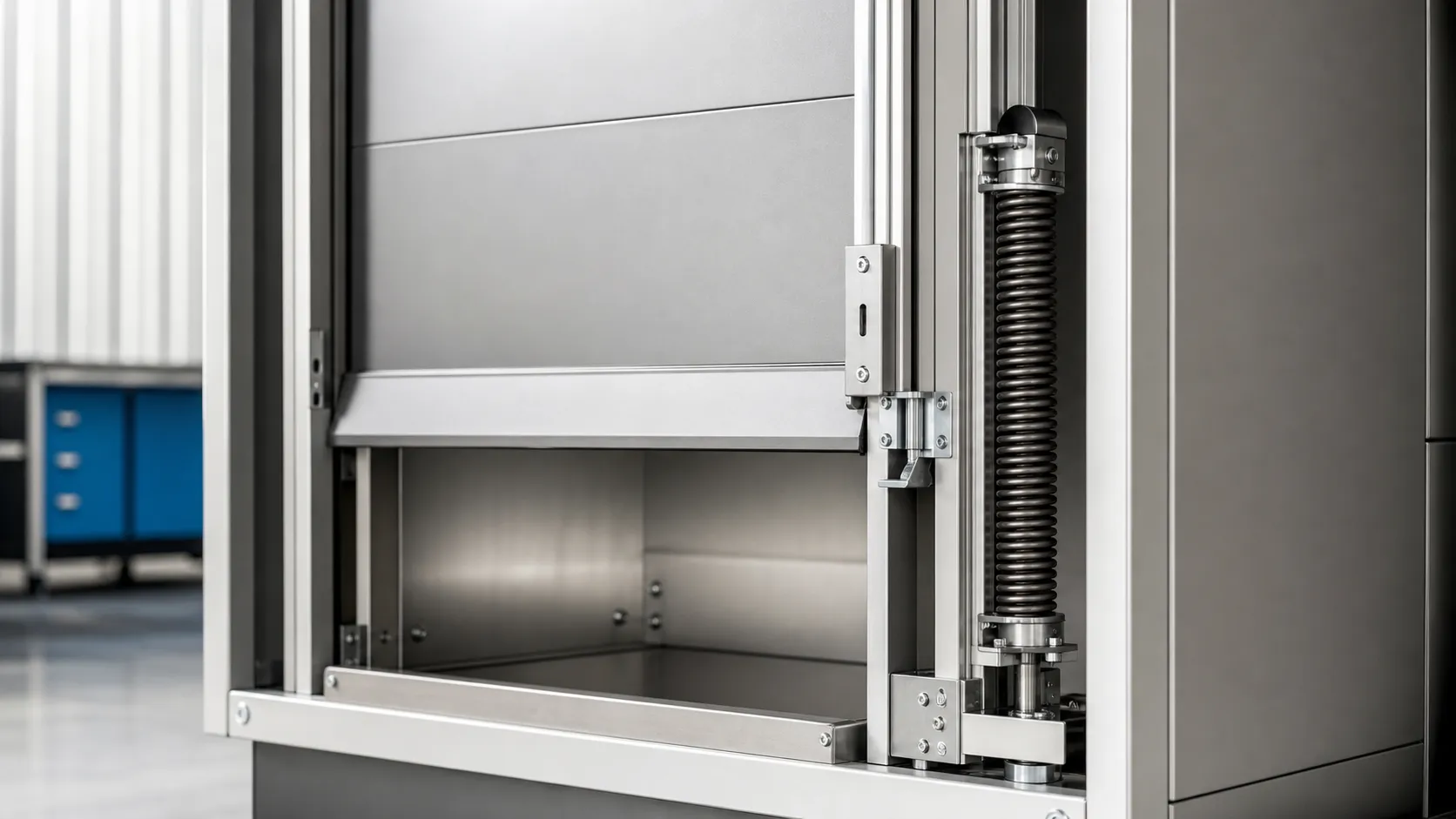
Constant force springs can help vertical sliding doors and compact equipment covers move smoothly with controlled counterbalance force. They are useful when a panel must lift vertically but the machine housing has limited space for large support components.
Unlike simple extension springs, constant force springs provide relatively stable force across the working stroke. This makes them suitable for guided sliding doors, small access covers, and compact product enclosures.
Quick answer: when should a vertical sliding door use a constant force spring?
Use it when the door needs smooth lift assist over a long stroke, predictable force, and compact installation inside the equipment body.
Application examples
- Vertical service doors
- Inspection panels
- Machine access covers
- Compact appliance doors
- Sliding protective panels
Key design inputs
| Input | Purpose |
|---|---|
| Door weight | Defines target counterbalance force. |
| Stroke length | Determines spring working length. |
| Guide friction | Affects opening and closing force. |
| Installation space | Controls spring drum and bracket layout. |
| Safety stop | Prevents uncontrolled movement at travel limits. |
Design tips
The spring should be mounted so force is aligned with the door movement. Guide rails, pulleys, brackets, and end stops should be reviewed together. If the door is heavy or safety-critical, the spring should not be the only protective element.
FAQ
Can constant force springs lift a vertical door?
They can assist or counterbalance the door, reducing user effort, but final design depends on weight, stroke, and guide friction.
What causes uneven sliding movement?
Rail friction, poor alignment, insufficient force, spring path interference, or weak bracket design can cause uneven movement.
Can the spring be hidden inside the product?
Yes. Many constant force spring mechanisms can be integrated inside the equipment housing.