
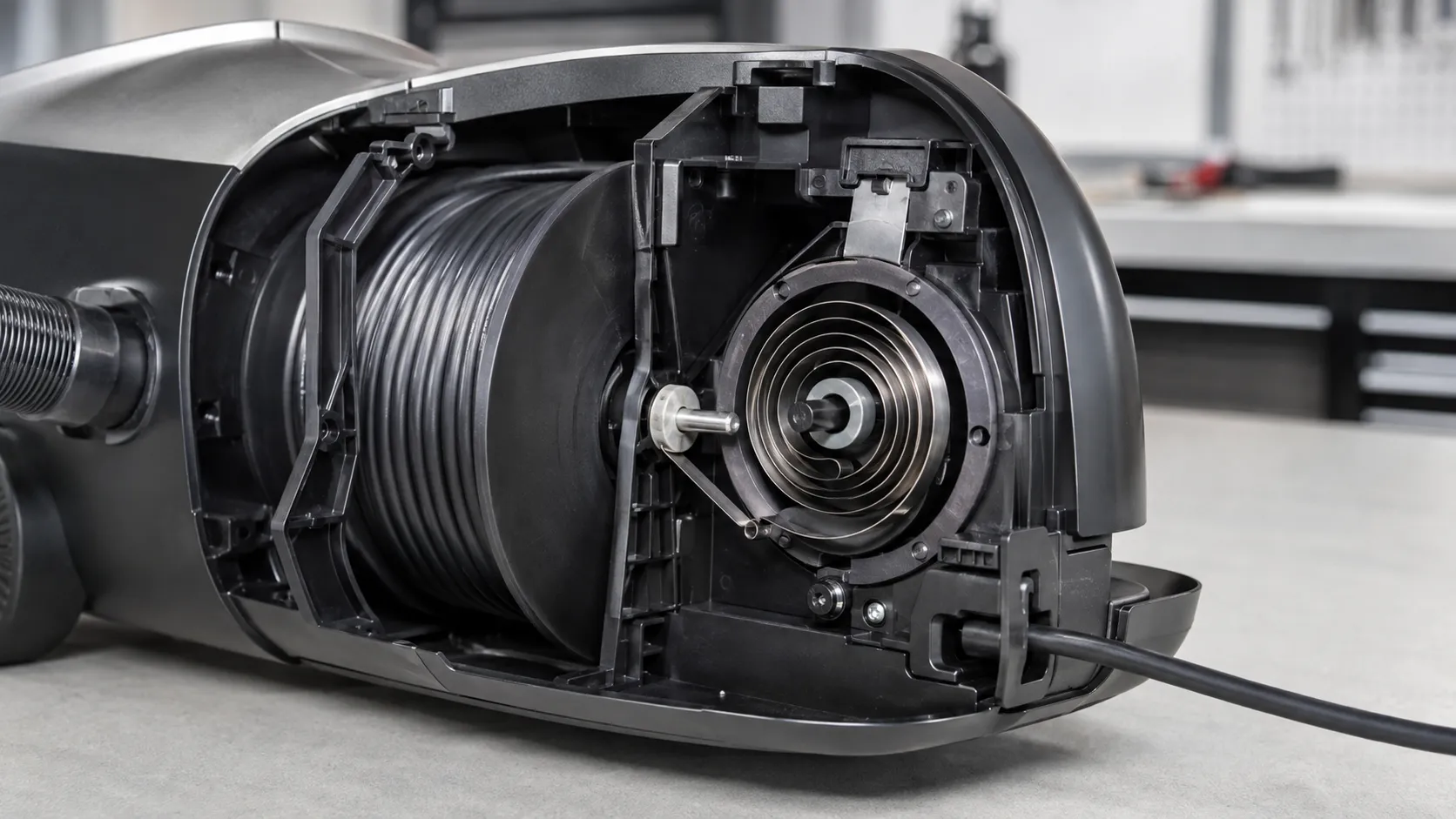
A power spring is the energy source in many vacuum cleaner cord rewind mechanisms: pulling out the cord winds the spring, and releasing the lock lets the spring rotate the reel to retrieve the cable.
For product teams comparing compact return and counterbalance options, the spring should be evaluated as part of the full mechanism. Shenzhen Leading Spring develops custom power springs around the required load, motion, space, attachments, environment, and production target.
Quick answer: when is this spring solution suitable?
A power spring is the energy source in many vacuum cleaner cord rewind mechanisms: pulling out the cord winds the spring, and releasing the lock lets the spring rotate the reel to retrieve the cable. It is most suitable when the product needs repeatable mechanical force in a compact package and the spring can be protected from over-travel, sharp edges, and misalignment.
Where this mechanism is used
- Canister vacuum cord reels
- Upright vacuum cable storage modules
- Commercial cleaning equipment
- Compact appliance cable retractors
How the spring works in the assembly
The spring must provide enough torque to overcome cable weight, reel inertia, guide friction, and the drag created by the electrical slip-ring or routing system. Excess torque makes the plug accelerate and strike the housing; insufficient torque leaves cable outside the machine. The useful design target is therefore a controlled torque curve across the actual number of reel turns, not the highest possible force.
Key design parameters
| Parameter | Why it matters |
|---|---|
| Cord length and mass | Define stored energy and torque demand. |
| Reel core diameter | Sets spring curvature and torque transfer. |
| Working turns | Controls travel and fatigue exposure. |
| Target return speed | Determines whether damping or gearing is needed. |
| Housing temperature | Affects material, lubrication, and long-term consistency. |
Common failure modes to prevent
Common problems include incomplete retraction, spring set, inner- or outer-end pullout, coil rubbing, excessive noise, and plug impact. They are often caused by an incorrect preload, too many working turns, sharp attachment geometry, contamination, or a reel path with more friction than the bench calculation assumed.
Recommended prototype and life testing
Measure pull force and return speed at minimum, middle, and maximum extension. Then cycle the complete cord reel with the production cable, plug, guides, lock, and housing. Include hot and cold conditioning if the appliance may be stored in vehicles, warehouses, or unconditioned rooms.
What to include in an RFQ
Provide cable length and weight, reel dimensions, available spring envelope, required working turns, desired pull force, return-time target, cycle-life goal, temperature range, and drawings of both spring attachments.
Custom spring development support
Shenzhen Leading Spring supports application review, custom spring design, prototypes, and production. Final force, torque, material, dimensions, and attachment details should be confirmed from the customer’s drawings and mechanism tests. To discuss a new project, contact our spring engineering team.
FAQ
How much preload does a vacuum cord reel need?
Preload must be established from reel friction and the required end-of-travel return force. It should be confirmed in the complete assembly rather than selected from a generic value.
Can a stronger spring fix slow retraction?
Sometimes, but high friction, poor cable layering, or a worn lock may be the real cause. Increasing torque without diagnosis can create impact and durability problems.
Should the spring be supplied in a cassette?
A cassette can simplify assembly and protect the strip, but the best format depends on housing space, production method, and service requirements.