
Exhausting a pneumatic supply does not by itself describe the state of a spring-return fixture. Air can remain in parts of a circuit, and a mechanical spring can retain energy after pneumatic pressure changes. The intended de-energized condition needs a system definition.

Identify the energy boundaries
Show the actuator chambers, relevant valves and mechanical spring connection. Use the circuit designer's documentation to identify which volumes are exhausted, isolated or otherwise controlled. A pressure reading at one point is not a description of every chamber.
State which movement the spring is intended to produce after the circuit reaches its defined state. Return may be a functional goal, but it should not be assumed to establish load support or prevent unexpected movement.
Evaluate the defined transition
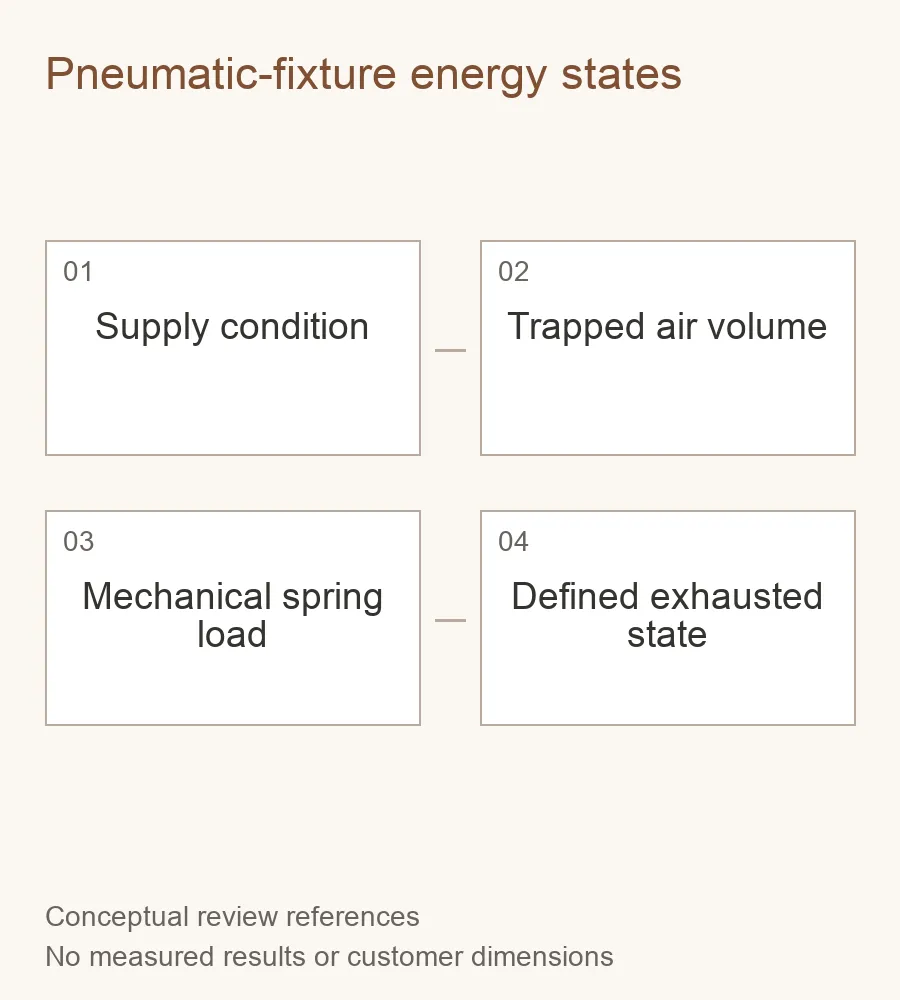
The responsible engineer should establish the isolation, restraint and test method. This article is not a procedure for venting a loaded fixture. Record pressure states and mechanical positions against the actual circuit and assembly revisions.
Keep the spring's output requirement separate from the circuit's safety functions. Festo's pneumatic safety material distinguishes specific energy-control functions; a generic spring-return label does not establish any one of them for a complete fixture.
A useful handover names the required exhausted state, the components that create it and the mechanical position expected afterward. Unresolved trapped-air or spring-energy questions remain system design inputs, not reasons to increase return force.
For the broader background, read Power Spring Dynamic Return Overspeed.
Explore related spring information or discuss this mechanism with a non-confidential description.
Background reference: Festo pneumatic safety functions. Component documentation does not qualify the complete mechanism.