
An encoder reference mark helps establish a position relationship, but it does not define the spring's installed state by itself. The controller coordinate, moving attachment and spring support must be connected through a documented physical reference.
Name the reference event
Record the encoder type, reference signal and direction used to establish position. An incremental index is not automatically a unique multi-turn assembly state. Use the selected encoder's documentation for its signal behavior.
Identify the attachment position when the reference event occurs. If gearing or a flexible connection lies between the encoder and attachment, include that relationship and any relevant lost motion.
Preserve the physical correspondence
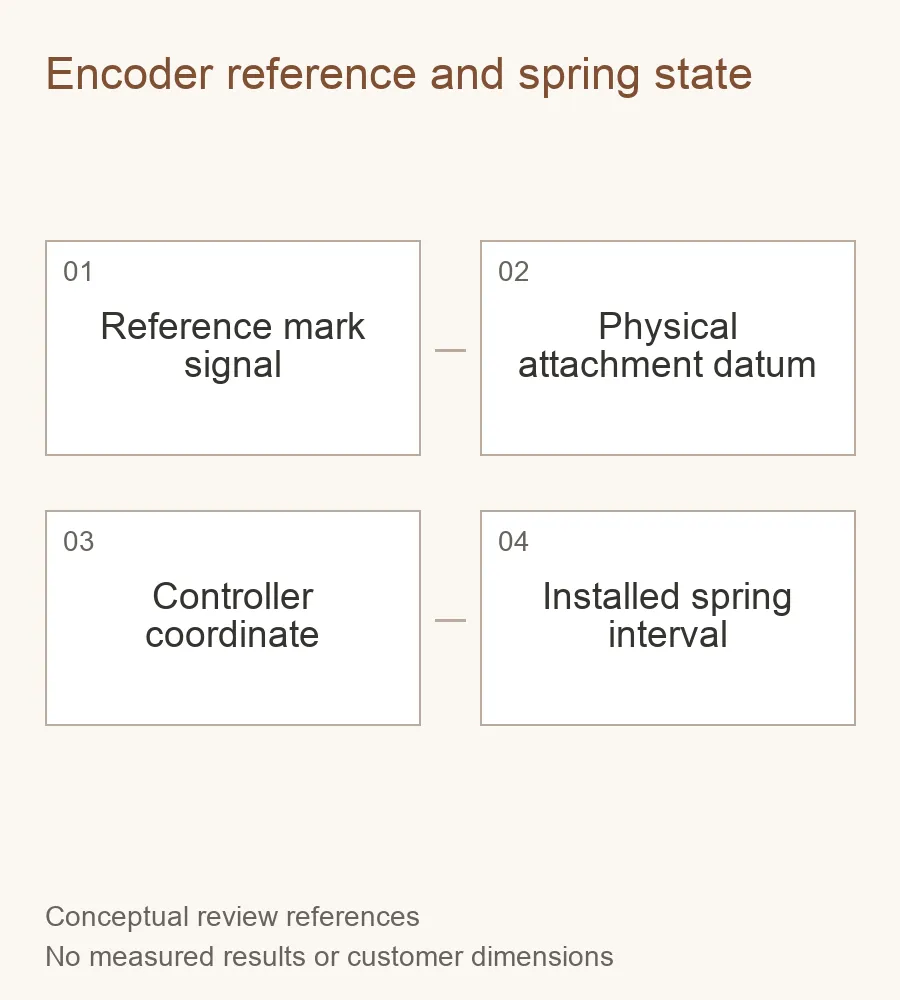
A controller offset can change displayed position without changing the spring's extension or winding. Keep the offset with the installed configuration rather than allowing it to hide a moved bracket or different preload state.
After a reference-setting change, compare the spring's physical operating interval with the intended travel. Do not rely only on the fact that the display again reads the same start and end values.
The acceptance record should connect the reference event, physical datum, coordinate convention and spring revision. This makes position data useful to the spring reviewer while keeping encoder behavior and mechanical travel limits as distinct requirements.

For the broader background, read Variable Force Spring Position Datum After Assembly.
Explore related spring information or discuss this mechanism with a non-confidential description.
Background reference: US Digital encoder signal reference. Component documentation does not qualify the complete mechanism.