
A cable that is frozen or heavily contaminated should not be treated as an ordinary high-friction spring test. Forcing return can move contamination into the reel, damage a cable or load an obstructed interface. The product needs a defined response to that observed condition.
Describe the condition before moving it
Record the visible contamination, cable position and affected opening without entering a hazardous path. The appropriate isolation, inspection and recovery procedure comes from the equipment and cable requirements, not from a generic spring article.
Do not apply extra force or substitute a stronger spring simply to demonstrate completion. Completion under an obstructed condition is not evidence of acceptable cable condition.
Separate environment from recovery
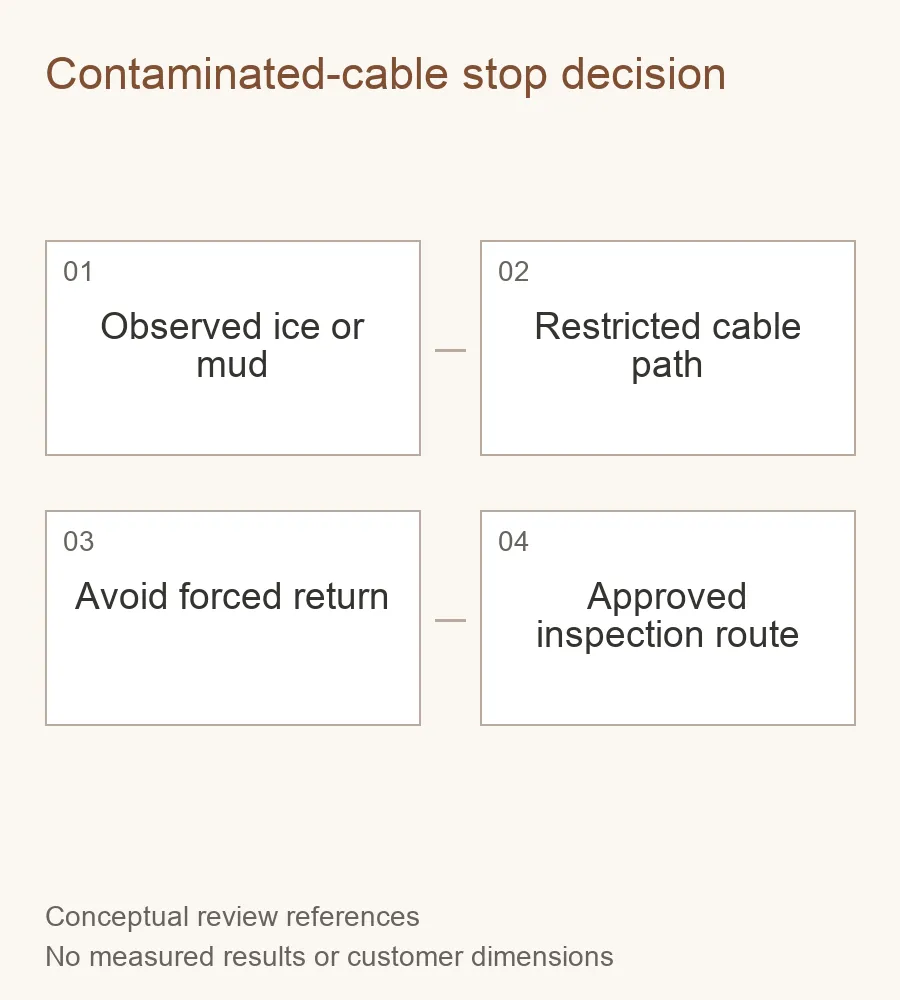
The product designer should decide which cold or dirty operating conditions are intended and which require stopping for inspection. These boundaries affect material, enclosure, routing and maintenance requirements as well as spring output.
After an approved recovery, assess the cable, entry, attachments and reel function according to the product procedure. A normal-looking return does not erase possible damage from the earlier obstruction.
The spring enquiry should state the intended environmental boundary clearly. If frozen-cable operation is not established, leave it outside the accepted claim rather than publishing an unsupported all-weather capability or an improvised de-icing method.
For the broader background, read Constant Torque Spring Performance at Temperature Extremes.
Explore related spring information or discuss this mechanism with a non-confidential description.