
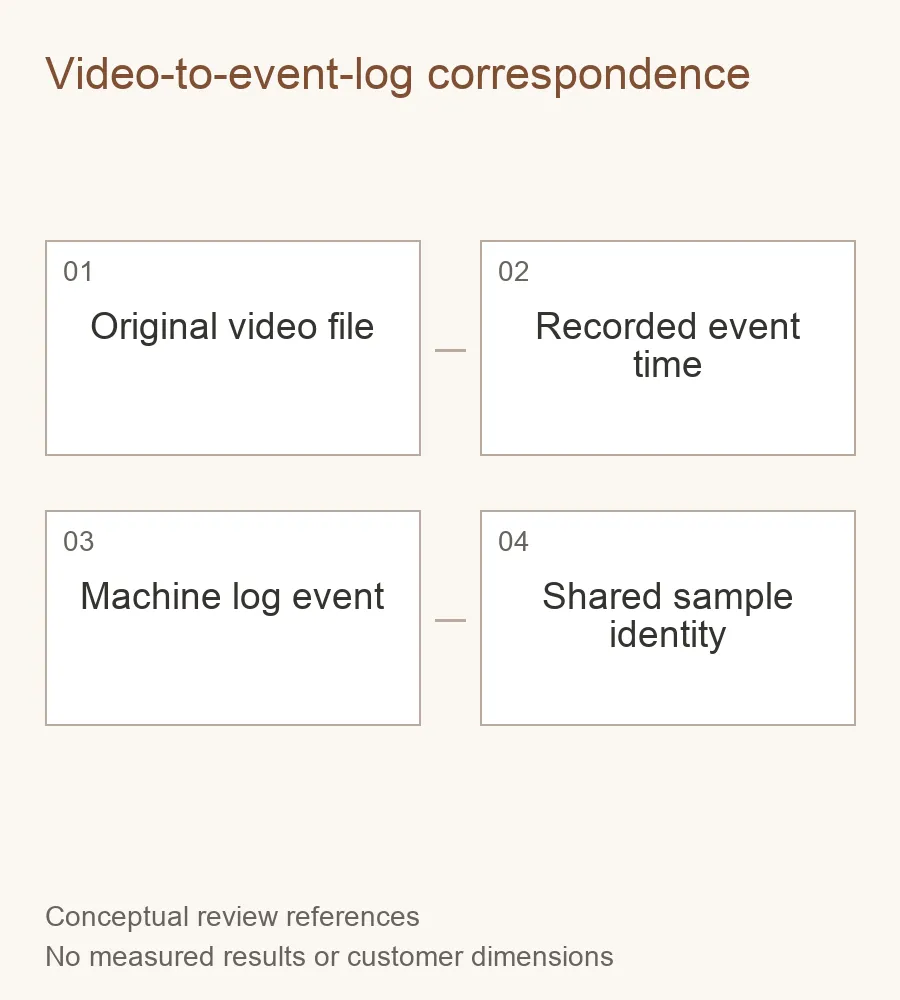
A video can show a return hesitation while a machine log records the related positions and signals. The two records become more useful when their correspondence is explicit. Matching file names alone does not establish time alignment.
Send a compact event record
Useful fields include:
- Sample and assembly revision identifiers.
- Video file identity and the relevant frame time or elapsed time.
- Log timestamp, its time basis and the named event.
- Position reference, motion direction and any known recording delay.
Only include information permitted for the review. Machine logs can contain customer names, paths or other unrelated details, so inspect the actual shared extract as carefully as the video.
Preserve the originals and the mapping
Keep the original recording and log in controlled records. If a trimmed clip or filtered log is shared, document how its timing relates to the originals. A clip that starts later should not retain an unexplained zero-time reference from the full recording.
Do not imply greater synchronization than the method supports. If the correspondence is approximate, state that limitation before using the records to assign a peak or delay to a particular mechanism event.
A short mapping note lets the spring reviewer connect visible behavior with recorded evidence without asking for a complete machine data dump. It supports an investigation; it does not turn a video into a force measurement or a completed life test.
For the broader background, read A Useful Video Brief for a Spring Return Problem.
Explore related spring information or discuss this mechanism with a non-confidential description.