
A spring assist near a conveyor can encounter a workpiece that does not arrive or clear as intended. That is a different load state from normal repeated actuation. A spring selected for the normal task should not silently become the device expected to clear any jam.

Separate operating and abnormal states
Describe normal part contact, the intended return movement and the physical features that can retain a workpiece. Identify the jammed states relevant to the machine assessment without inventing an uncontrolled release test.
Name the component responsible for the machine's response. A spring, stop, actuator and control system may have different responsibilities; none should acquire an unspecified protective role simply because it sits closest to the obstruction.
Keep the spring requirement bounded
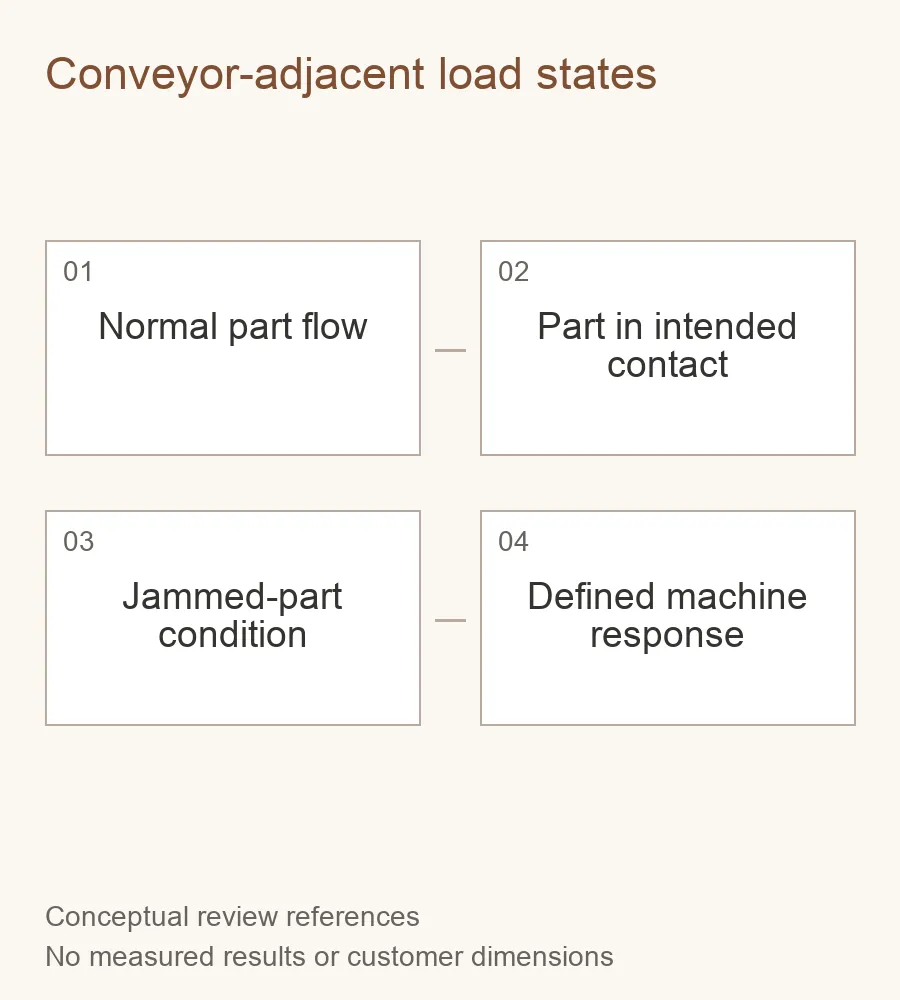
State the loads and travel that the assist must handle during the permitted sequence. If the product requires a controlled response to blocked movement, define that requirement through the machine designer and applicable component documentation.
For validation, use the approved risk assessment, restraint and test method. Do not place a workpiece into a hazardous path to see whether a stronger spring can move it.
The handover should distinguish normal completion from the response to an unresolved obstruction. This allows the spring to be discussed as a defined mechanical contribution while leaving machine-level protection and recovery with the responsible design.
For the broader background, read Spring Overtravel Evidence from Stop Marks.
Explore related spring information or discuss this mechanism with a non-confidential description.