
Illustrative application image. This image is not evidence of a customer installation or a validated spring assembly.
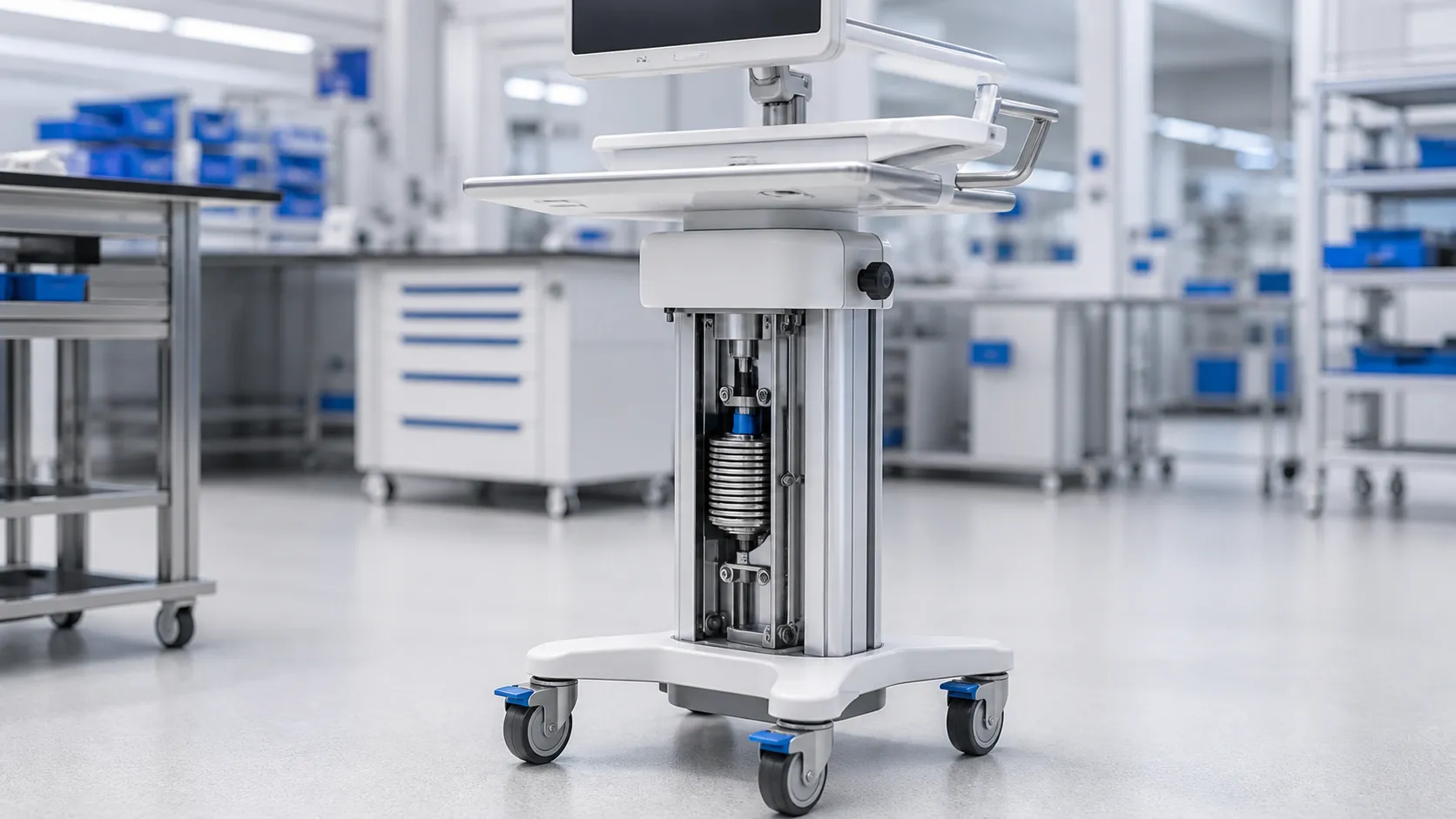
A constant force spring helps offset the weight of a tray, monitor, or equipment column so users can adjust cart height with lower effort and smoother movement. For manufacturers designing height-adjustable medical carts, the right spring layout can improve movement feel, reduce operator effort, and make the mechanism easier to package inside a compact product.
Shenzhen Leading Spring manufactures custom springs for B2B applications where movement, return force, torque, and space limitations must be balanced carefully. A constant force spring can be adapted for the product geometry, working stroke, cycle life, and user feel required by the complete assembly.
Quick answer: when does this spring solution make sense?
A constant force spring helps offset the weight of a tray, monitor, or equipment column so users can adjust cart height with lower effort and smoother movement.
Common applications
- Medical monitor carts
- Mobile diagnostic carts
- Adjustable medication workstations
- Procedure carts with lift columns
- Compact healthcare equipment stands
Key design parameters
| Parameter | Why it matters |
|---|---|
| Moving load | Defines the balancing force needed for the lift column. |
| Stroke length | Determines the spring working travel and storage space. |
| Column friction | Affects the final hand force after assembly. |
| Cleanability | Important for exposed healthcare equipment surfaces. |
| Cycle life | Supports repeated adjustment in hospitals and clinics. |
Engineering selection checklist
Confirm the full moving mass, desired hand force, stroke, guide friction, installation space, cleaning requirements, and expected adjustment cycles. Testing should be done in the complete cart column because slides, cables, and accessories change the final feel.
How to evaluate the spring inside the complete mechanism
The spring should not be selected only by catalog force or torque. Engineers should test it with the real guide rails, shafts, cables, hinges, covers, stops, and friction sources. This helps confirm opening force, return speed, noise, safety margin, and long-term consistency before tooling or production release.
Custom spring manufacturing support
Shenzhen Leading Spring supports custom constant force spring design, samples, and production for medical carts, healthcare equipment, and compact lift-assist systems. For drawings, samples, or application review, contact Shenzhen Leading Spring.
FAQ
Can constant force springs reduce cart adjustment effort?
Yes. They can offset part of the moving load so height adjustment feels lighter and more controlled.
What data is needed for a medical cart spring?
Moving weight, stroke, column space, target force, mounting direction, and cycle-life target are the key inputs.
Can the spring be designed for compact columns?
Yes. Strip width, thickness, coil diameter, and mounting layout can be customized for limited space.