
Illustrative application image. This image is not evidence of a customer installation or a validated spring assembly.
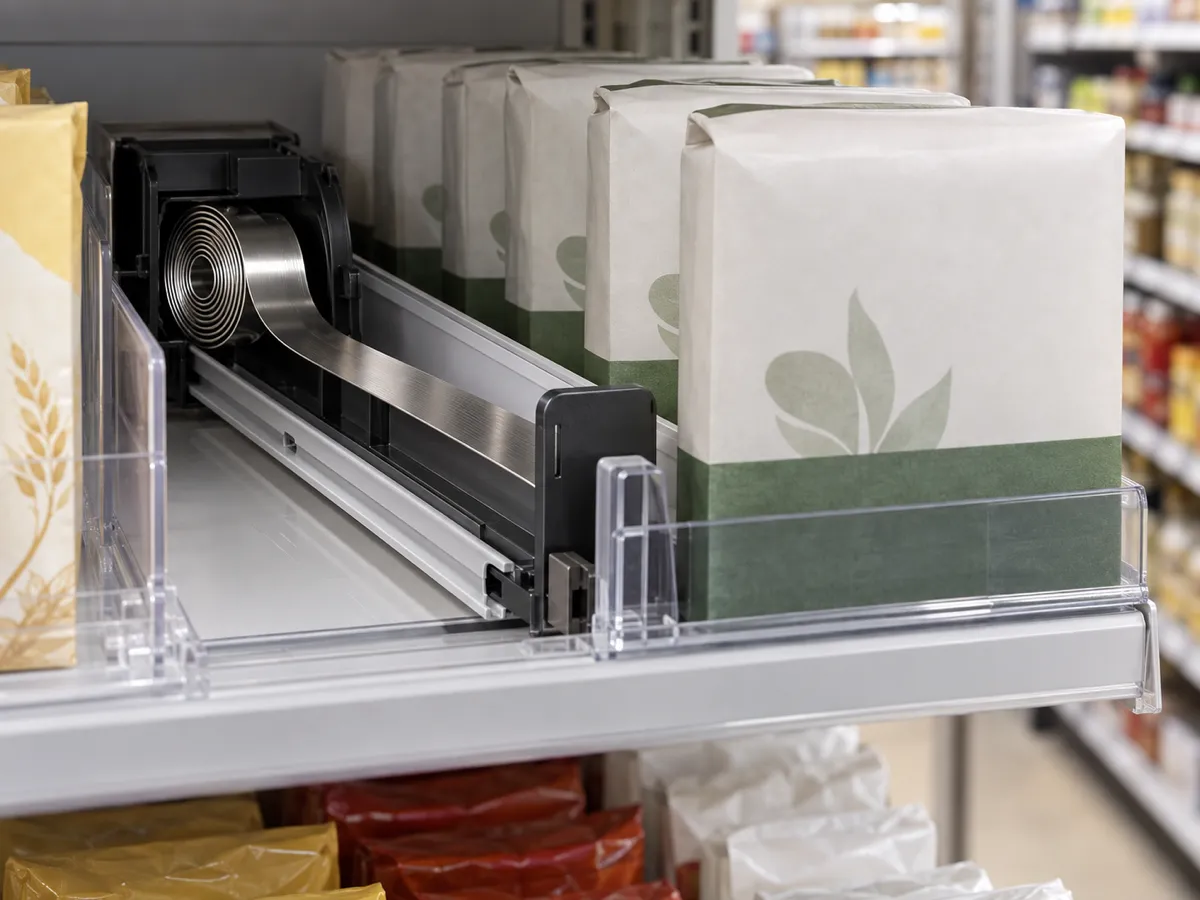
A constant force spring can provide compact, repeatable motion control in a retail shelf pusher system when its force, travel, attachments and protection are designed around the complete assembly.
Explore constant force springs for product information.
Quick answer
The spring strip extends along the shelf rail and pulls the pusher toward the front as products are removed. The useful force window must advance packages without crushing lightweight cartons or causing unstable stacks. A production-ready design therefore balances user feel, reliable return or holding behavior, fatigue margin and safe mechanical stops.
Typical applications
- OEM retail shelf pusher system assemblies
- Compact product pusher carriage return modules
- Custom mechanisms with limited installation space
- Prototype-to-production motion-control programs
Key design parameters
| Parameter | Why it matters |
|---|---|
| Moving load | Defines the force or torque needed at each position. |
| Travel and geometry | Determine spring working range, spool or pivot dimensions and preload. |
| Available envelope | Limits strip width, coil diameter, housing and attachment options. |
| Environment | Guides material, surface protection, lubricant and sealing choices. |
| Cycle-life target | Sets fatigue margin and validation duration. |
Failure modes to prevent
Common risks include stalled pushers, excessive package pressure, strip kinks, contamination drag, carriage derailment and coil damage during refill. These are often caused by excessive working travel, sharp attachment geometry, poor alignment, contamination or a production assembly whose friction differs from the prototype.
Prototype and life testing
Measure pusher force at the beginning and end of usable shelf travel with representative product packs. Observe whether guides bind or packs tip before changing the spring output.
What to include in an RFQ
Provide product mass and footprint, lane length, required push force, rail friction, strip width, coil space, cleaning chemicals, and refill cycles. Drawings or a 3D model of both spring attachments and the complete motion path help the engineering team avoid assumptions.
Custom development support
Discuss your application and arrange a private channel for detailed drawings.
FAQ
How is the spring size selected for a retail shelf pusher system?
State the range of pack sizes and mass, shelf orientation and available travel. Define an acceptable pusher-force window for the actual merchandise rather than selecting by a single nominal force.
Can one constant force spring design cover several product variants?
Compare pack mass, dimensions, shelf travel and friction for each merchandise range. One pusher force may tip light packs or fail to advance heavier ones.
Why are end stops important?
Provide a stop that retains the carriage within its intended travel. Check product containment and edge contact in the assembled shelf, including the lowest-stock condition.