
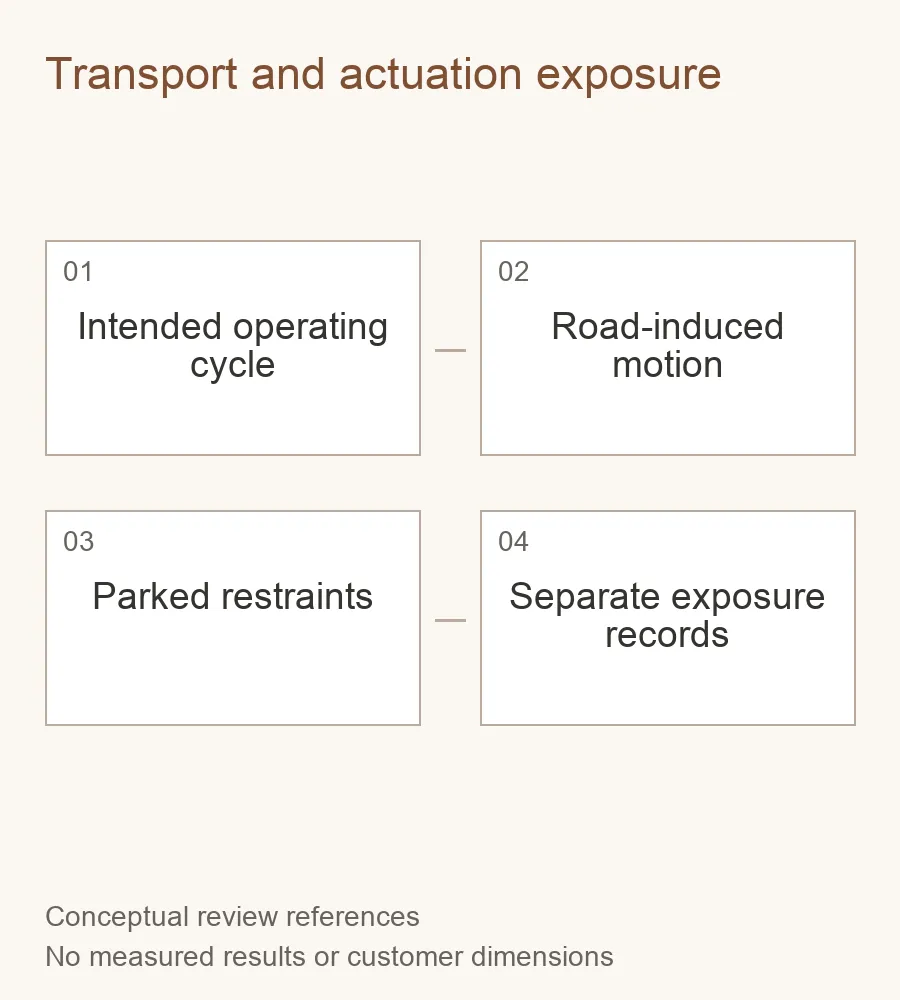
Road vibration and deliberate spring actuation are different exposures. A parked mechanism can experience small repeated movements during transport without completing a normal operating stroke. Counting only full actuations may omit that condition, while converting all vibration into equivalent cycles without a justified model can mislead.

Keep the histories separate
Record intended actuation travel and the transport or vehicle-installed state. Identify restraints, contact points and whether the spring remains loaded. A reel locked for shipping is not the same configuration as one operating freely in a vehicle.
The responsible product engineer should define the relevant vibration environment and evaluation. Do not invent a generic road spectrum or service-life conversion for a spring family.
Inspect the interfaces affected
Small relative movements can occur at attachments, supports or contacting surfaces even when the main output looks stationary. Tie inspection observations to those locations and to the known exposure history.
A successful actuation test after transport is useful, but it does not by itself explain wear or establish long-term performance. Retain the evidence for each exposure rather than merging it into one unexplained cycle total.
The spring review should state which operating and parked conditions belong in qualification. For vehicle applications, component evidence remains separate from any required complete-system or safety qualification.
For the broader background, read Spring Environmental Test Sequence.
Explore related spring information or discuss this mechanism with a non-confidential description.