
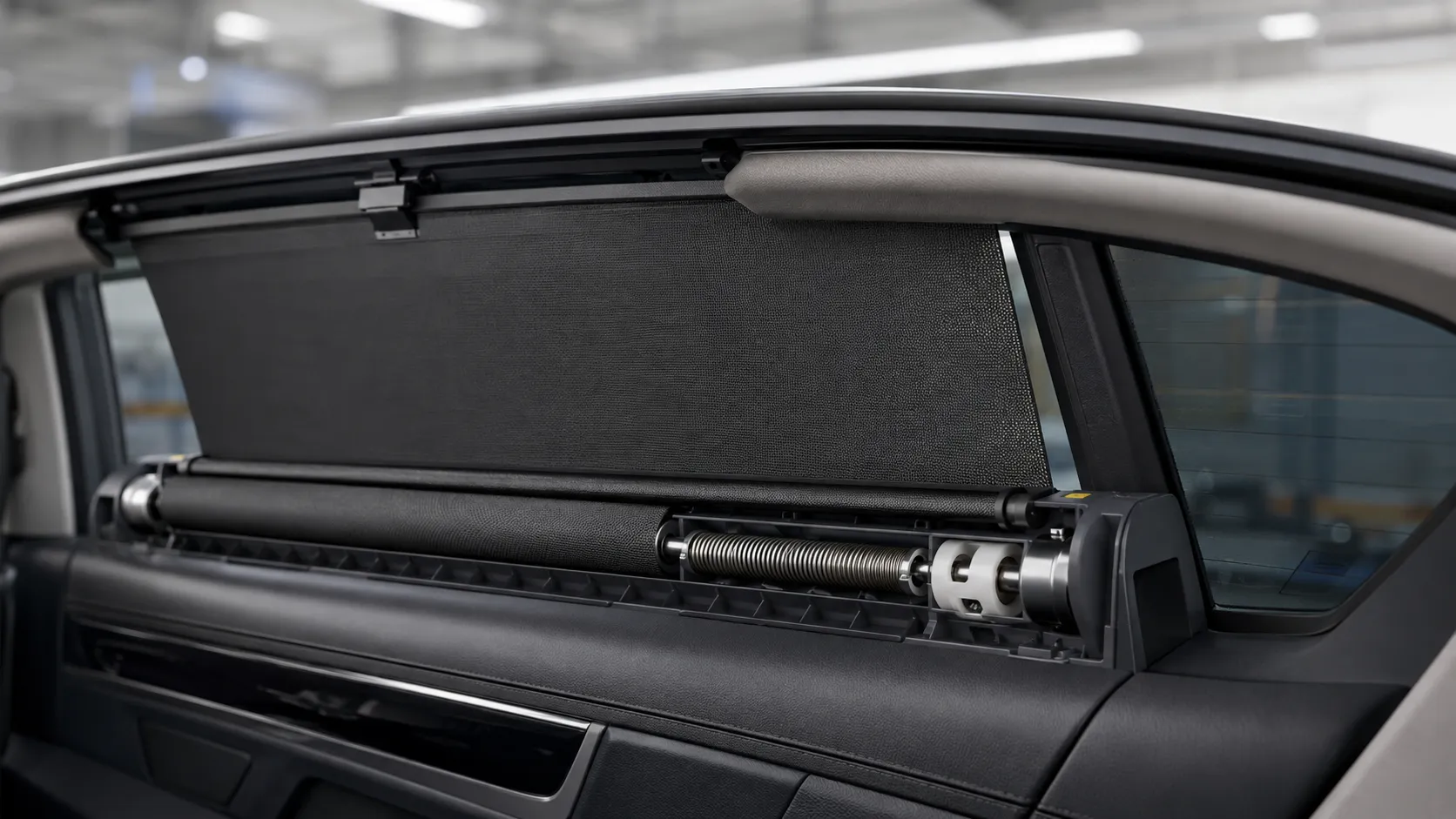
A power spring can rotate the roller in an automotive retractable sunshade, keeping fabric tensioned during travel and returning the shade into its cassette after release.
For product teams comparing compact return and counterbalance options, the spring should be evaluated as part of the full mechanism. Shenzhen Leading Spring develops custom power springs around the required load, motion, space, attachments, environment, and production target.
Quick answer: when is this spring solution suitable?
A power spring can rotate the roller in an automotive retractable sunshade, keeping fabric tensioned during travel and returning the shade into its cassette after release. It is most suitable when the product needs repeatable mechanical force in a compact package and the spring can be protected from over-travel, sharp edges, and misalignment.
Where this mechanism is used
- Rear-window sunshades
- Door-window roller shades
- Panoramic roof shade modules
- Cargo-area privacy screens
How the spring works in the assembly
Sunshade torque must be high enough to overcome fabric, guide, and seal friction but low enough for quiet, controlled travel. The effective load changes with roller build-up and shade angle. Vehicle interiors also expose the spring to heat, vibration, dust, and long dwell periods at partial or full extension.
Key design parameters
| Parameter | Why it matters |
|---|---|
| Shade mass and width | Set the basic roller load. |
| Roller tube diameter | Changes torque-to-tension conversion. |
| Deployment length | Defines the working rotation range. |
| Cabin temperature range | Influences material and lubricant selection. |
| Noise target | Controls clearances, guides, and spring containment. |
Common failure modes to prevent
Design teams should watch for slow return after hot soak, fabric wrinkles, roller skew, coil noise, end-hook fatigue, and over-speed near stowage. Spring torque alone cannot correct misaligned guides or inconsistent fabric winding.
Recommended prototype and life testing
Test return time, edge tracking, noise, and handle force across the full stroke. Add thermal cycling, high-temperature dwell at extension, vibration, and repeated partial-stroke use. Inspect attachments and the spring pack after testing rather than relying only on functional pass/fail.
What to include in an RFQ
Include shade dimensions and mass, roller diameter, extension length, available cassette volume, target handle force, return speed, installation orientation, temperature range, vibration requirement, and expected cycles.
Custom spring development support
Shenzhen Leading Spring supports application review, custom spring design, prototypes, and production. Final force, torque, material, dimensions, and attachment details should be confirmed from the customer’s drawings and mechanism tests. To discuss a new project, contact our spring engineering team.
FAQ
Can one spring design serve several shade widths?
Possibly, if roller load and travel remain within the validated torque window. Different fabric mass or roller diameter may require a new spring setting.
Why test a sunshade after hot soak?
Cabin heat can change lubrication, polymer clearances, fabric drag, and the spring system's return behavior.
Can a power spring hold the shade at intermediate positions?
The spring provides return torque; intermediate holding normally also requires a latch, brake, or controlled drive mechanism.