
An adjustable hub can change a spring return's installed angular relationship without changing the spring part. If the hub setting is not recorded, two assemblies with identical parts can begin operation from different spring states.

Define what the adjustment moves
Show the hub relative to the housing, spring attachment and output shaft. State whether adjustment changes preload, output orientation or both. Do not describe the setting only as a number of visible holes if those holes can be assembled in more than one orientation.
Use a named datum and viewing side for angular references. Witness marks are helpful only when the drawing explains which marks correspond and under what supported assembly condition.
Keep setting and verification together
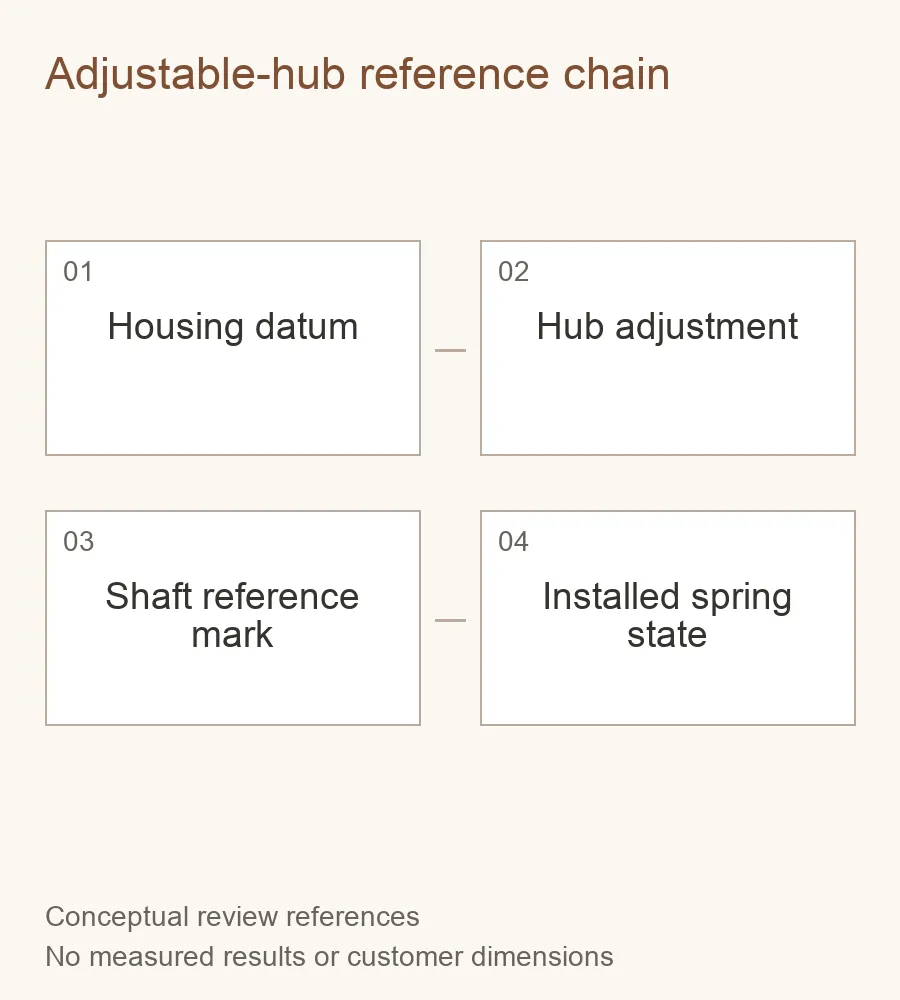
Record the adjustment position before the functional test. If it changes during troubleshooting, preserve the earlier value and identify the new configuration. Otherwise an improvement may be wrongly attributed to a different spring rather than a changed installed state.
Check that the final setting preserves the required operating rotation and the specified limits. Correct output orientation alone does not establish an acceptable spring winding state.
Any adjustment involving stored energy needs the module's approved installation procedure and restraint. The public review question is about traceability, not instructions for loosening a loaded hub. The completed record should connect hub setting, output datum, spring identity and the functional result so that production can reproduce the approved assembly.
For the broader background, read Constant Torque Spring Torque Sign Convention.
Explore related spring information or discuss this mechanism with a non-confidential description.