
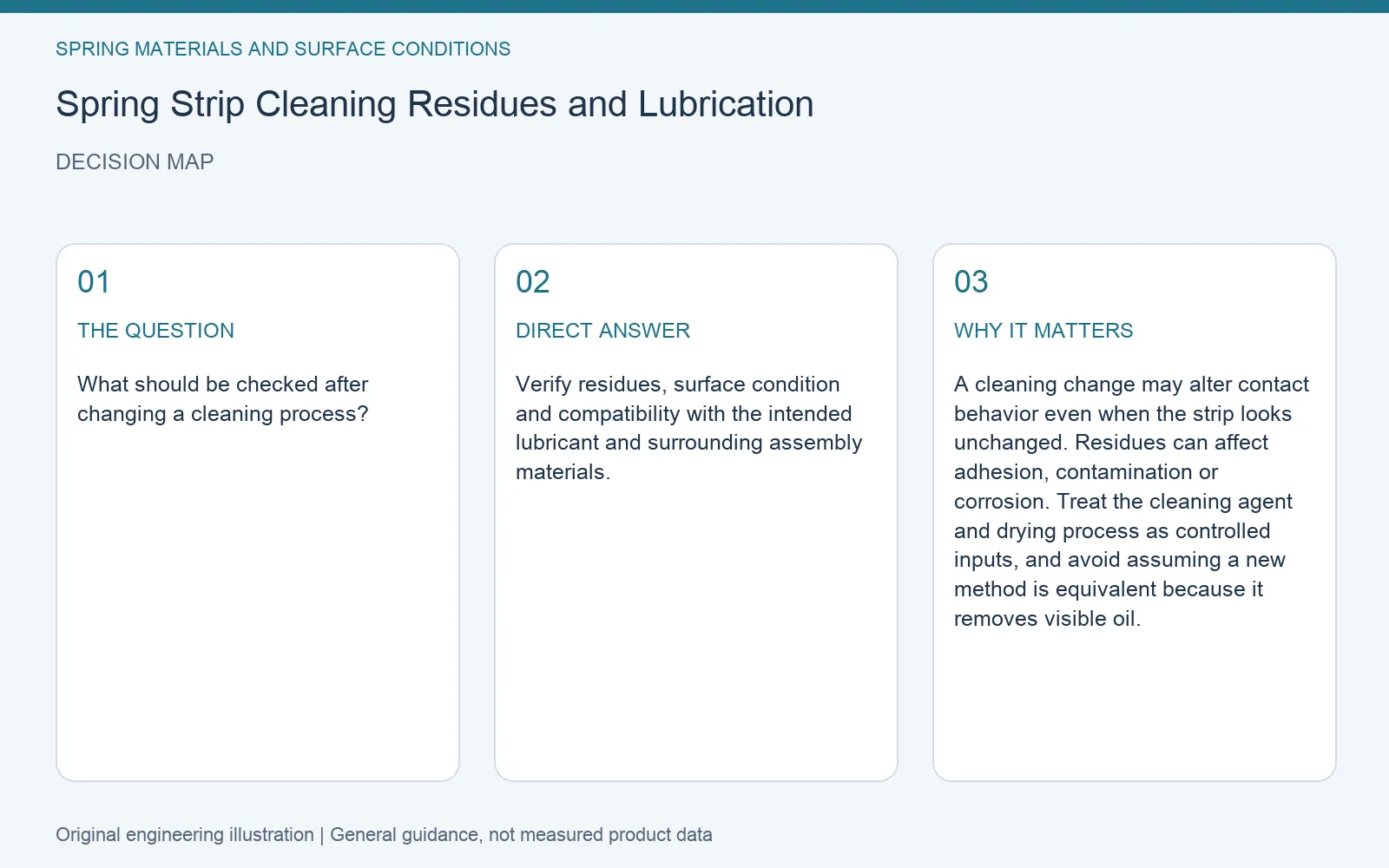
Quick answer: Verify residues, surface condition and compatibility with the intended lubricant and surrounding assembly materials.
What should be checked after changing a cleaning process?
A cleaning change may alter contact behavior even when the strip looks unchanged. Residues can affect adhesion, contamination or corrosion. Treat the cleaning agent and drying process as controlled inputs, and avoid assuming a new method is equivalent because it removes visible oil.
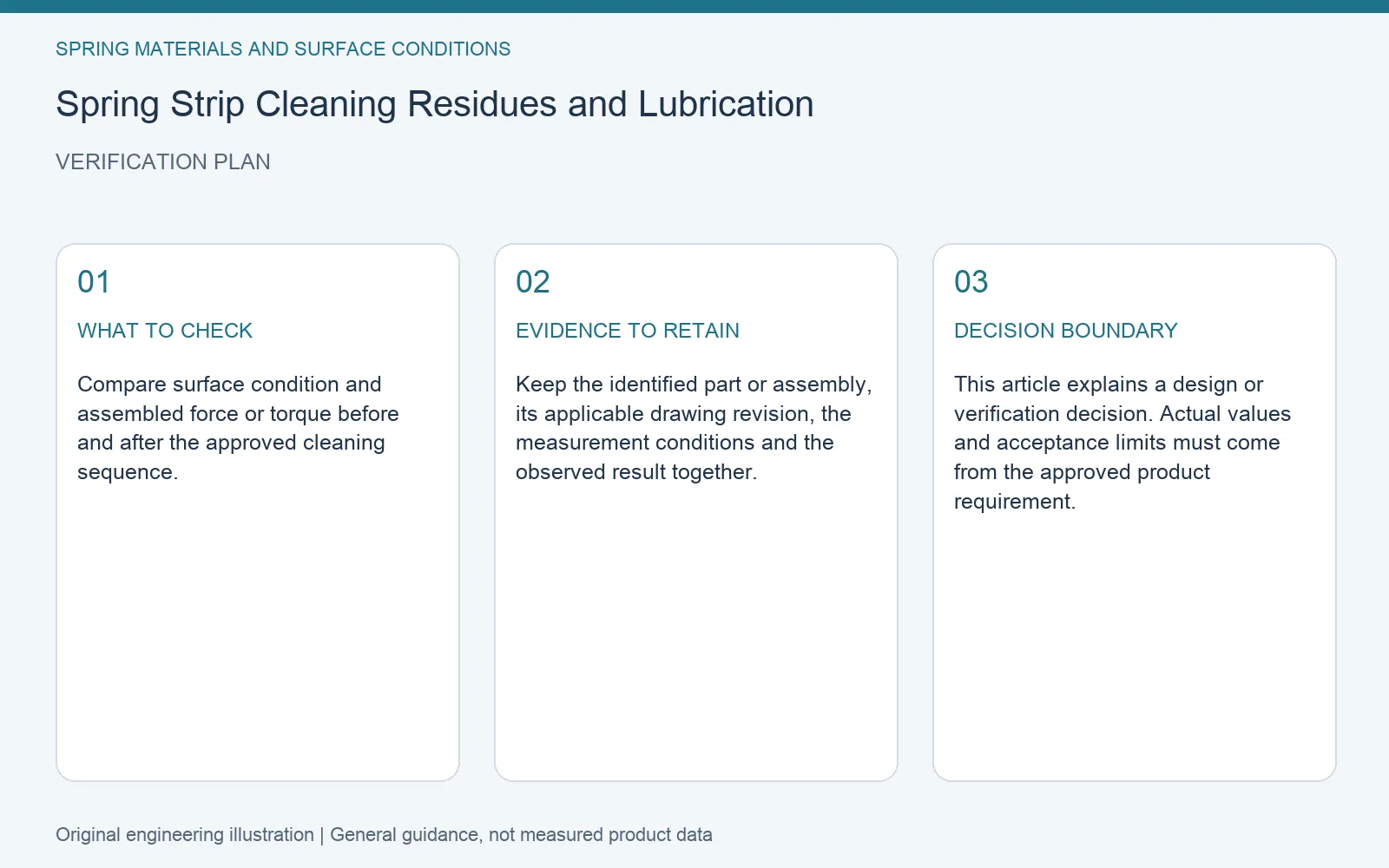
A practical verification method
Compare surface condition and assembled force or torque before and after the approved cleaning sequence.
| Item | What to record | Purpose |
|---|---|---|
| Reference configuration | Part or assembly identity and drawing revision | Make comparisons traceable |
| Test conditions | Relevant position, direction and operating condition | Compare the same characteristic |
| Decision evidence | Compare surface condition and assembled force or torque before and after the approved cleaning sequence. | Resolve the specific question before approval |
Use the result in an engineering request
Describe the observed condition and the required function separately. Include the relevant drawing revision and your results from the check above. If an acceptance limit has not been established, identify it as an open design input rather than treating a successful trial as approval.
Review the related Leading Spring product information. For a project-specific review, send the mechanism description, available geometry and the evidence relevant to this decision through the contact page.
Editorial note: AI-assisted engineering guidance, prepared from the topic-specific reasoning shown here and the company’s public product context. Illustrations explain decisions; they are not customer-case photographs or test results. Product-specific suitability requires review against your approved requirements.