
A power spring (also called a clock spring) is a type of rotary spring. It is made by placing a steel strip that has been coiled once or twice into a fixed housing, then connecting it to a central arbor and winding it to a preset position. When the preload is released as needed, the spring uses the rebound force of the wound strip to achieve the intended design function. The English name is power spring. Common shapes are shown below:
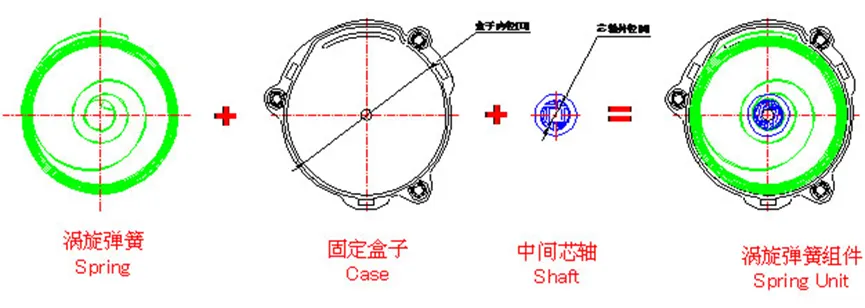
Advantages: Because it is designed for rotational use, it can be widely applied in circular devices and designed coaxially with a cord-reel mechanism, which saves a lot of space. With a well-engineered design, the maximum service life can reach up to 300,000 cycles.
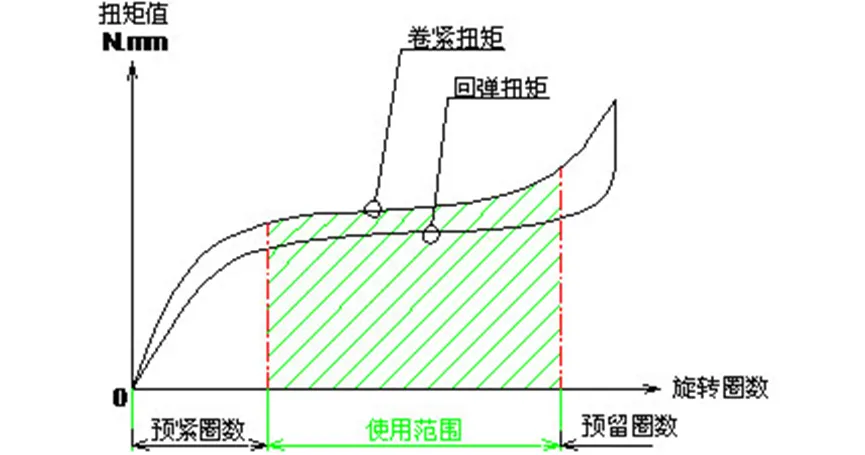
Disadvantages: Because it works in rotation, the torque is not uniform during the rebound stroke. It is weaker at the beginning and stronger later. Therefore, it cannot meet requirements where balanced torque is needed throughout the stroke. The torque curve is shown below:

II. Applications of Spiral Springs
- Cord reel (cable winder)
Cord reels are widely used for storing power cords in small household appliances such as electric irons, hair dryers, vacuum cleaners, and rice cookers. As users increasingly care about the appearance of appliances, exposed cords can look dirty, be easily damaged, and be inconvenient to store. With a cord-reel mechanism, the cord is fully stored inside, solving these issues. The key component is the spiral spring.
- Automotive seat belts
In today’s automotive market, almost all vehicles use various safety devices, including active and passive safety systems. The two main passive safety systems are airbags and seat belts. Seat belts are mandatory, making them the most frequently used safety device in a car. The retraction of the seat-belt webbing relies entirely on the torque output of the spiral spring. A well-designed spiral spring delivers a long service life and extremely low torque decay, which is a critical guarantee for long-term reliable seat-belt operation.
- Engine starting devices
Widely used in starting mechanisms for engines such as those in yachts, lawn mowers, and chainsaws.
- Sports equipment
To meet strict demands for neatness and aesthetics, devices such as retractable table-tennis nets use a line-retraction design. With a dual-spring design, the net line can be neatly retracted into the reel housing. Strength-training equipment also increasingly adopts spiral springs to improve service life, making the product more attractive and more durable.
- Dog leashes and barrier-belt retraction devices
For people who walk dogs, a retractable leash with a webbing retraction mechanism avoids the long leash dragging on the ground and getting dirty. By selecting products with different torque levels, it can suit dogs of different weights and types. Banks, post offices, and other public places also use large quantities of various spiral springs in barrier belts.
III. Spiral Spring Design
The following parameters must be provided for spiral spring design:
- Inner diameter of the housing (D)
- Diameter of the central arbor (d)
- Torque value (T)
- Working range (Nx to Ny)
- Service life requirement
- Torque calculation: Requires dedicated software. Please contact our company.
- Life calculation: Requires dedicated software. Please contact our company.
- Automotive seat belts
In today’s automotive market, almost all vehicles use various safety devices, including active and passive safety systems. The two main passive safety systems are airbags and seat belts. Seat belts are mandatory, making them the most frequently used safety device in a car. The retraction of the seat-belt webbing relies entirely on the torque output of the spiral spring. A well-designed spiral spring delivers a long service life and extremely low torque decay, which is a critical guarantee for long-term reliable seat-belt operation.
- Product torque calculation (requires dedicated software; please contact our company)
- Product life calculation (requires dedicated software; please contact our company)