
Illustrative application image. This image is not evidence of a customer installation or a validated spring assembly.
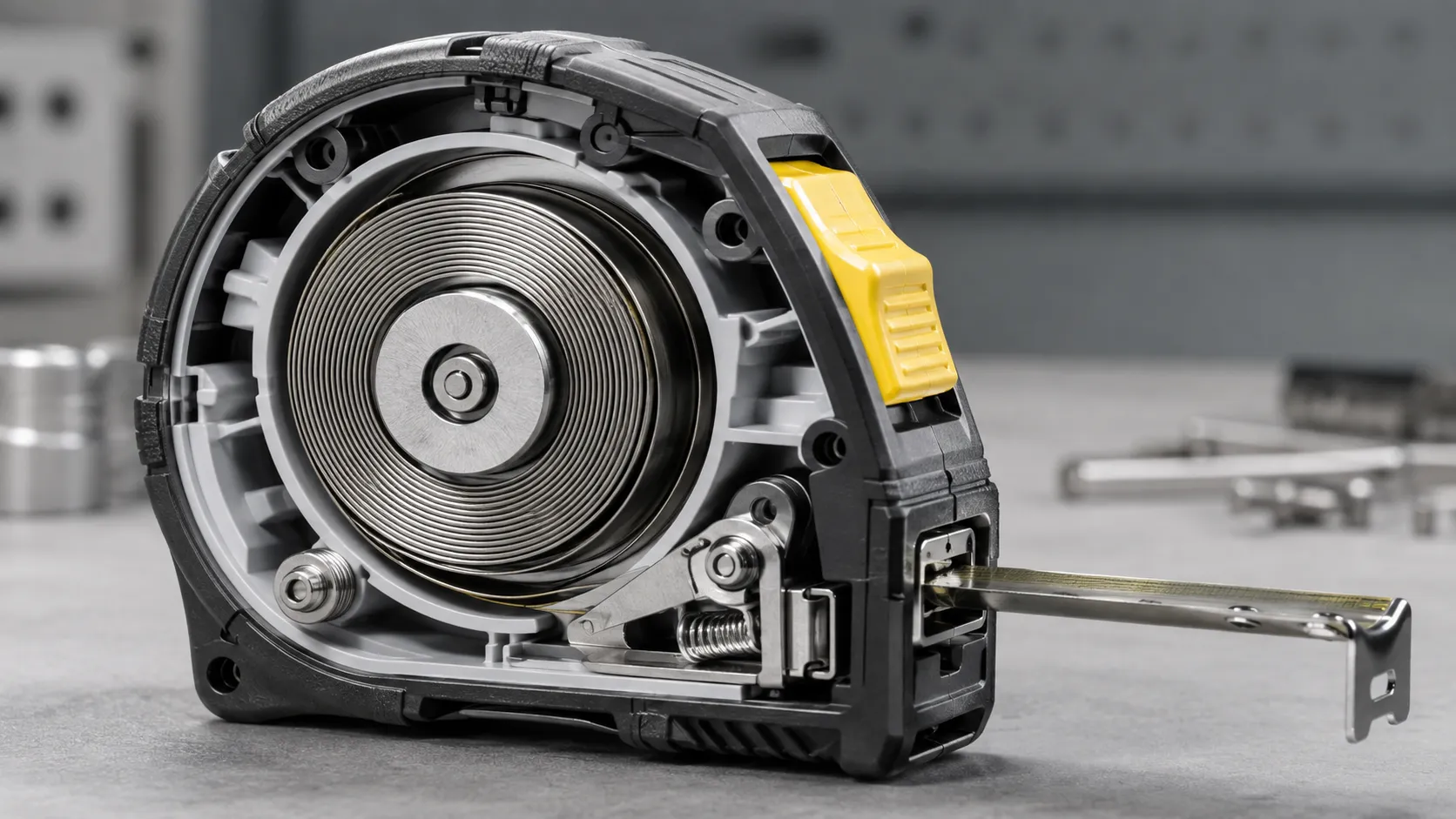
In a retractable tape measure, the power spring winds as the blade is extended and returns the blade to the case when the brake is released. Reliable performance depends on torque balance, attachment strength, and fatigue life.
Explore power springs for product information.
Quick answer: when is this spring solution suitable?
In a retractable tape measure, the power spring winds as the blade is extended and returns the blade to the case when the brake is released. Reliable performance depends on torque balance, attachment strength, and fatigue life. It is most suitable when the product needs repeatable mechanical force in a compact package and the spring can be protected from over-travel, sharp edges, and misalignment.
Where this mechanism is used
- Pocket tape measures
- Long-reach measuring tapes
- Tailor and body-measuring tapes
- Retractable inspection rulers
How the spring works in the assembly
The reel radius changes as the blade layers onto the spool, so the spring torque and the blade pull force do not remain identical through the stroke. A good design has enough reserve to retrieve the last section of blade without making full extension uncomfortable. The brake, blade curvature, mouthpiece, and spool alignment all influence the force that users actually feel.
Key design parameters
| Parameter | Why it matters |
|---|---|
| Blade length | Determines reel rotation and energy requirement. |
| Blade width and thickness | Affect mass, stiffness, and spool capacity. |
| Spool diameter | Converts spring torque into blade pull force. |
| Preload turns | Provide return force near full retraction. |
| Extension cycles | Drive fatigue and attachment requirements. |
Common failure modes to prevent
Typical failures are sluggish final return, blade snap-back, fractured spring ends, spring nesting, and permanent torque loss. A small attachment radius or burr can concentrate stress, while excessive preload consumes fatigue margin before the user extends the blade.
Recommended prototype and life testing
Record pull force every 20 to 25 percent of extension, verify brake holding force, and measure return time. Cycle samples at normal and maximum extension, then inspect the spring ends, spool slot, and coil surfaces for wear or edge damage.
What to include in an RFQ
Share blade length, width, thickness, total mass, spool core diameter, available spring width and outer diameter, pull-force window, preload, maximum turns, and life target.
Custom spring development support
Check blade payout and return with the intended blade, hook and housing installed. Record where the blade rubs or changes layering; a spring-only torque result does not establish blade return or dimensional accuracy.
Describe blade length and section, spool geometry, intended working turns and stopping arrangement. Ask for an assembled return and attachment review without treating the spring as the routine travel stop. Discuss this application.
FAQ
Why does a tape measure stop before the blade is fully retracted?
The remaining spring torque may be lower than mouthpiece, brake, or spool friction. Dirt and damaged blade edges can also increase resistance.
Does a longer blade always require a thicker spring?
No. Strip width, thickness, coil diameter, material, preload, and spool geometry must be considered together.
Can the return speed be reduced?
Yes. Torque can be tuned, and the product may use friction or damping, but changes must still leave enough end-of-stroke return force.