
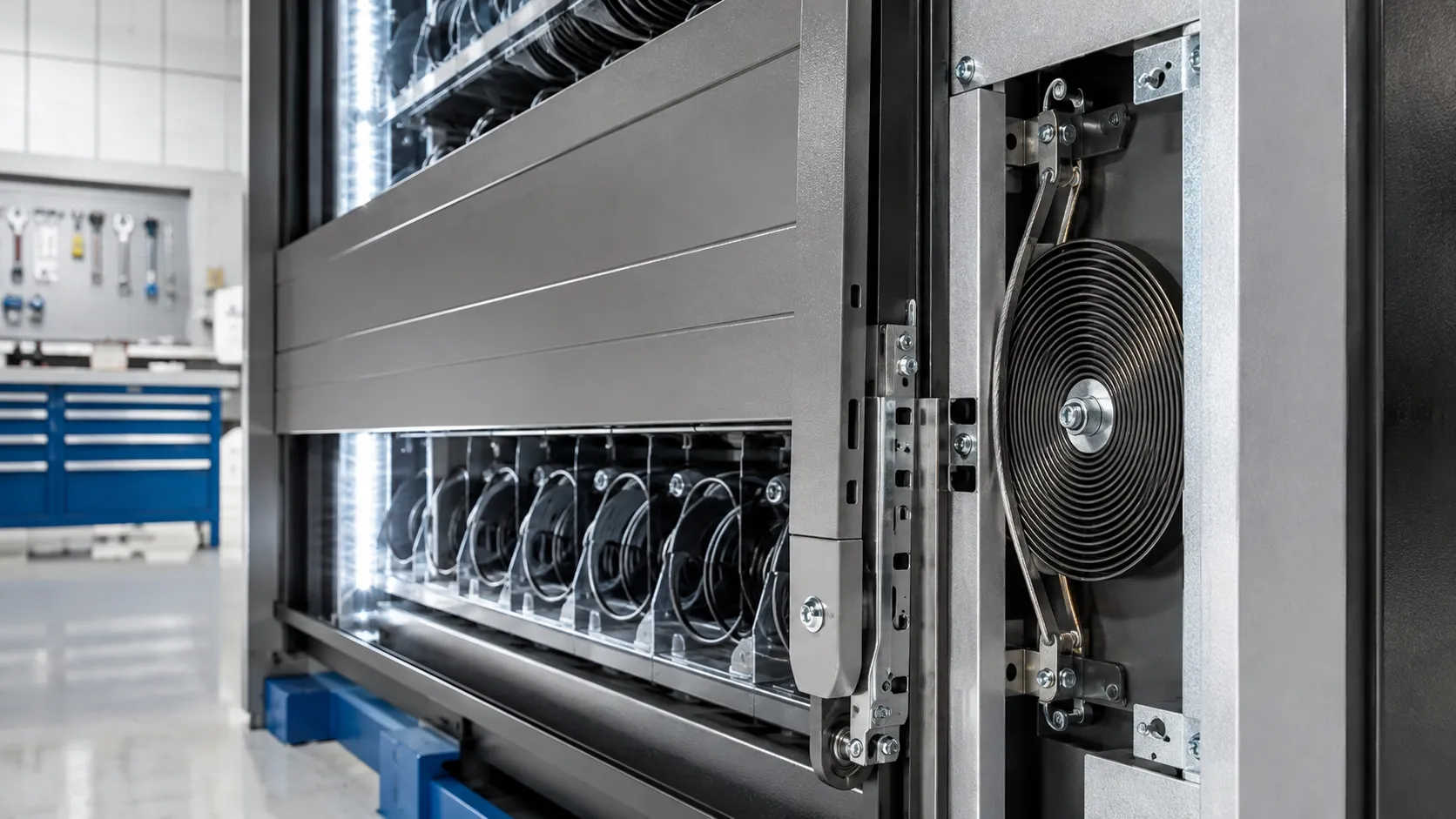
A constant force spring can counterbalance a vertical vending machine access door, reducing lifting effort and controlling the apparent door weight through most of the travel.
For product teams comparing compact return and counterbalance options, the spring should be evaluated as part of the full mechanism. Shenzhen Leading Spring develops custom constant force springs around the required load, motion, space, attachments, environment, and production target.
Quick answer: when is this spring solution suitable?
A constant force spring can counterbalance a vertical vending machine access door, reducing lifting effort and controlling the apparent door weight through most of the travel. It is most suitable when the product needs repeatable mechanical force in a compact package and the spring can be protected from over-travel, sharp edges, and misalignment.
Where this mechanism is used
- Product retrieval doors
- Service access shutters
- Automated retail pickup compartments
- Vertical equipment covers
How the spring works in the assembly
The spring force should offset the moving door mass plus a carefully chosen margin for seals and guides. Dual springs may reduce racking on wide doors. The coil, strip path, carrier, and end attachments must fit outside product and customer contact zones while remaining serviceable.
Key design parameters
| Parameter | Why it matters |
|---|---|
| Door mass | Defines required counterbalance force. |
| Vertical stroke | Sets active strip length and mounting position. |
| Guide friction | Changes user lifting and closing effort. |
| Side-channel space | Limits coil and carrier dimensions. |
| Daily vend cycles | Set fatigue and contamination requirements. |
Common failure modes to prevent
Potential problems include a door that drops, rises by itself, binds near one end, or becomes heavier after contamination. Unequal spring forces, damaged guides, edge wear, and weak attachments can all affect the mechanism. Positive stops and guarding should manage foreseeable over-travel and user contact risks.
Recommended prototype and life testing
Measure opening and closing force throughout the stroke, not only at mid-travel. Cycle the production door with seals, guides, locks, sensors, and any product chute loads in place. Add dust, temperature, and reasonable misuse checks based on the vending environment.
What to include in an RFQ
Share door mass and dimensions, stroke, guide type and friction estimate, number of springs, mounting envelope, target hand force, operating orientation, environmental exposure, safety-stop layout, and cycle target.
Custom spring development support
Shenzhen Leading Spring supports application review, custom spring design, prototypes, and production. Final force, torque, material, dimensions, and attachment details should be confirmed from the customer’s drawings and mechanism tests. To discuss a new project, contact our spring engineering team.
FAQ
Can a constant force spring keep the door open?
It can balance much of the weight, but a latch, detent, friction feature, or stop may be needed to guarantee a service position.
Why use two springs on a wide lift door?
A balanced pair can reduce racking and distribute force, provided both sides are matched and aligned.
What if the door gets heavier after assembly?
Glass, trim, wiring, locks, and seals can change the final load. Force selection should use the complete production-equivalent door.