
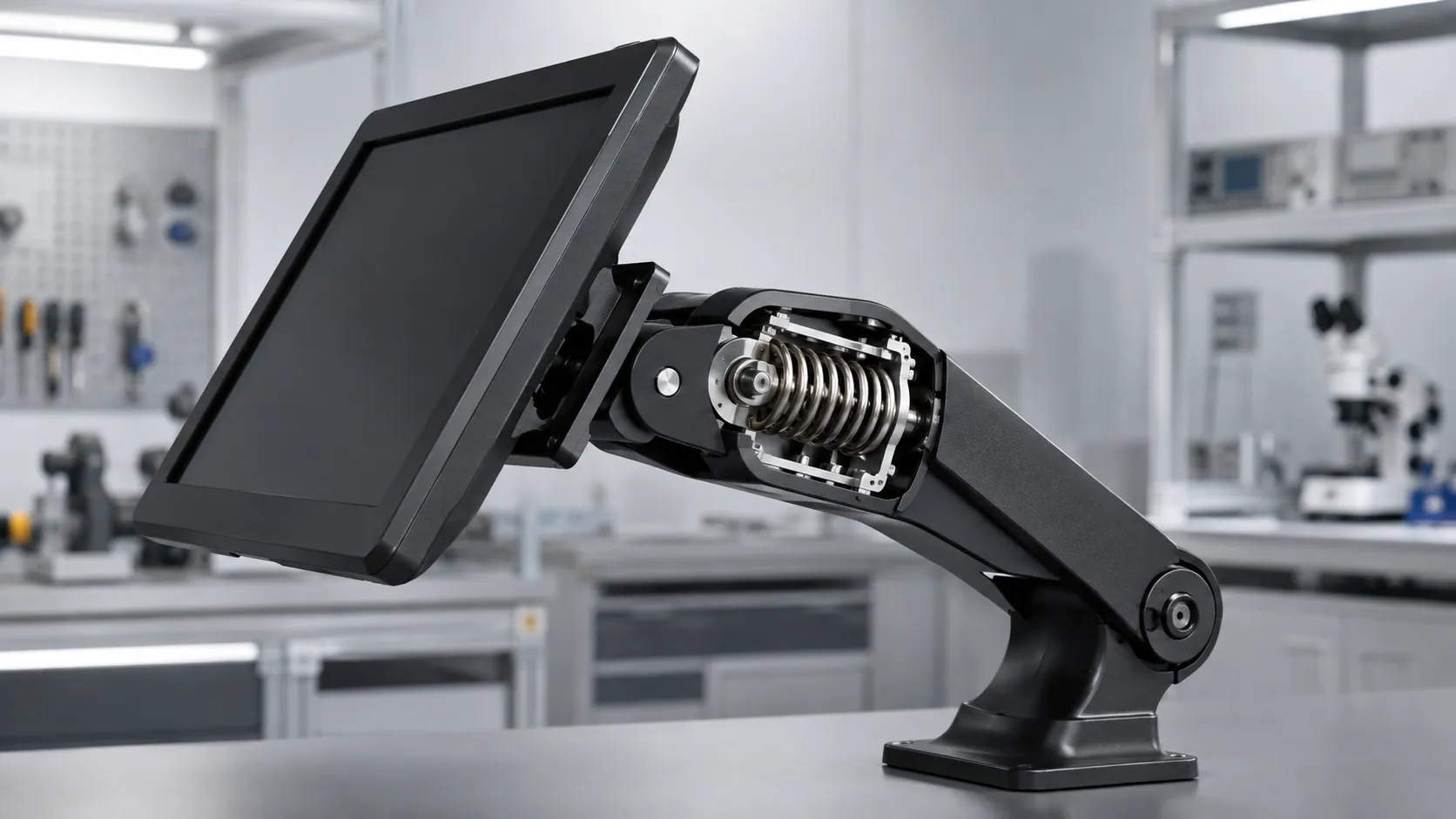
A constant torque spring can counterbalance the rotational moment of a POS display, helping users tilt or reposition the monitor with lower effort and more consistent feel.
For product teams comparing compact return and counterbalance options, the spring should be evaluated as part of the full mechanism. Shenzhen Leading Spring develops custom constant torque springs around the required load, motion, space, attachments, environment, and production target.
Quick answer: when is this spring solution suitable?
A constant torque spring can counterbalance the rotational moment of a POS display, helping users tilt or reposition the monitor with lower effort and more consistent feel. It is most suitable when the product needs repeatable mechanical force in a compact package and the spring can be protected from over-travel, sharp edges, and misalignment.
Where this mechanism is used
- Point-of-sale touchscreens
- Customer-facing payment displays
- Industrial HMI arms
- Compact medical and laboratory monitors
How the spring works in the assembly
Display torque demand depends on mass and the perpendicular distance from the pivot to the center of gravity. That moment changes with arm and screen angle. The spring can offset much of the load, while controlled hinge friction helps hold a chosen position and absorb small variations between display models.
Key design parameters
| Parameter | Why it matters |
|---|---|
| Display mass | Sets the base balancing requirement. |
| Center-of-gravity distance | Determines moment at the pivot. |
| Tilt-angle range | Defines working rotation. |
| Pivot diameter and width | Limit spring and shaft packaging. |
| Holding-force window | Balances easy adjustment with position stability. |
Common failure modes to prevent
An under-balanced arm falls; an over-balanced arm rises. Excess hinge friction hides poor balance and can create stick-slip motion. Other risks include cable torque, pivot wear, spring misalignment, noise, and attachment fatigue after frequent cashier adjustments.
Recommended prototype and life testing
Measure adjustment force and holding drift at multiple angles with minimum and maximum display masses. Cycle the arm with production cables installed, because cable routing adds moment and friction. Check fastener loosening, wear, temperature effects, and user pinch-clearance controls.
What to include in an RFQ
Provide display mass range, center-of-gravity coordinates, arm geometry, tilt angles, target adjustment force, desired holding behavior, pivot envelope, cable routing, installation orientation, and cycle-life target.
Custom spring development support
Shenzhen Leading Spring supports application review, custom spring design, prototypes, and production. Final force, torque, material, dimensions, and attachment details should be confirmed from the customer’s drawings and mechanism tests. To discuss a new project, contact our spring engineering team.
FAQ
Can one monitor arm support several screen weights?
A defined mass range is possible when spring torque and hinge friction are designed for it, but the range must be validated at all angles.
Does the spring hold the screen in position by itself?
It balances load; controlled friction, detents, or another holding feature may still be needed for stable positioning.
Why include cables in the test?
Power and data cables add bending resistance and torque that can change adjustment force and screen drift.