
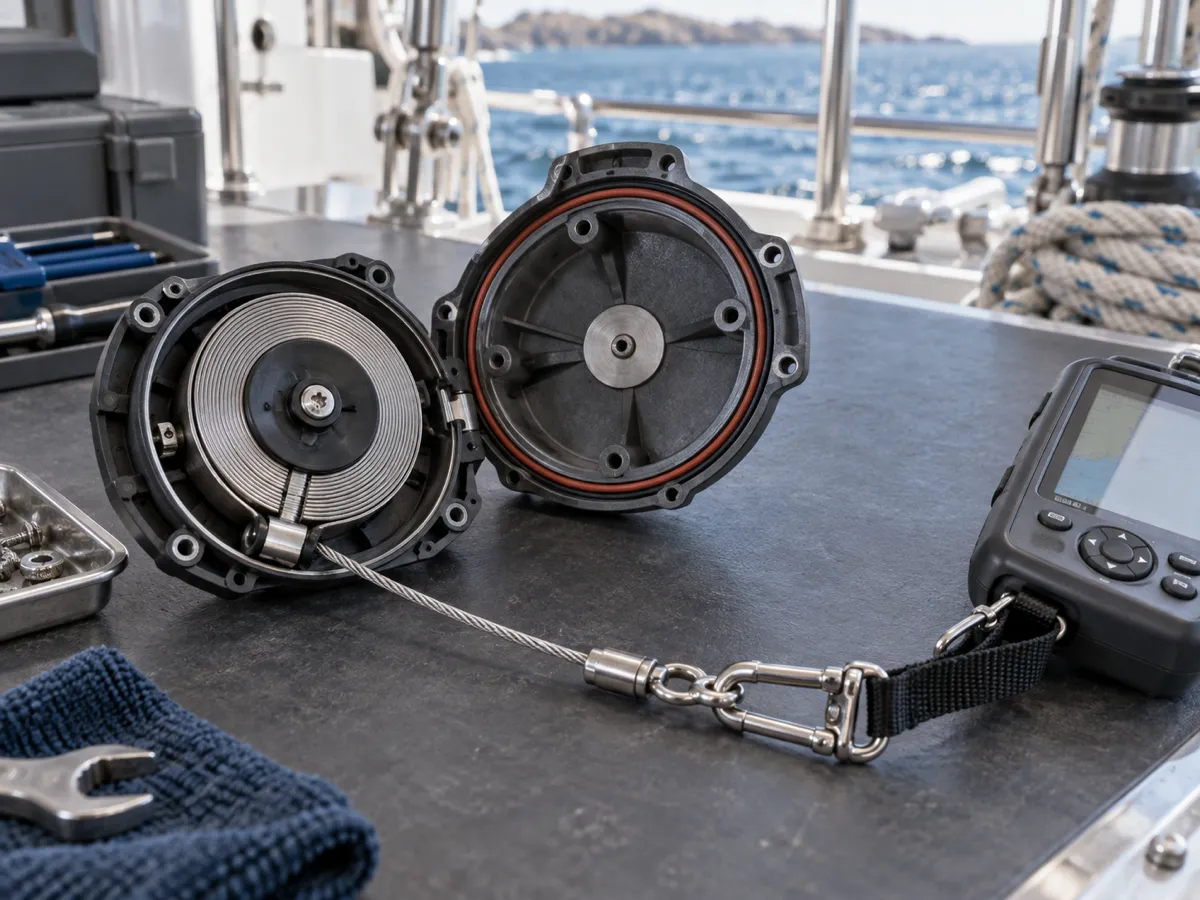
A cable spring can provide compact, repeatable motion control in a marine instrument safety tether when its force, travel, attachments and protection are designed around the complete assembly.
For engineering teams comparing compact return, counterbalance and positioning options, the spring should be evaluated as one part of the full mechanism. Shenzhen Leading Spring develops custom cable springs around the required load, motion, package, environment and production target.
Quick answer
A corrosion-resistant retractor keeps a handheld navigation or inspection instrument attached to the vessel while allowing normal use. The spring, cable, fasteners and housing must be evaluated together for salt, spray and shock loads. A production-ready design therefore balances user feel, reliable return or holding behavior, fatigue margin and safe mechanical stops.
Typical applications
- OEM marine instrument safety tether assemblies
- Compact handheld marine instrument and stainless tether return modules
- Custom mechanisms with limited installation space
- Prototype-to-production motion-control programs
How the mechanism works
A corrosion-resistant retractor keeps a handheld navigation or inspection instrument attached to the vessel while allowing normal use. The spring, cable, fasteners and housing must be evaluated together for salt, spray and shock loads. The real output is also affected by bearings, guides, seals, cables, latches and manufacturing tolerances. Testing only the loose spring can miss the friction and alignment conditions that determine field performance.
Key design parameters
| Parameter | Why it matters |
|---|---|
| Moving load | Defines the force or torque needed at each position. |
| Travel and geometry | Determine spring working range, spool or pivot dimensions and preload. |
| Available envelope | Limits strip width, coil diameter, housing and attachment options. |
| Environment | Guides material, surface protection, lubricant and sealing choices. |
| Cycle-life target | Sets fatigue margin and validation duration. |
Failure modes to prevent
Common risks include corrosion, water ingress, cable bird-caging, weak return, clip failure and spring damage after shock loading. These are often caused by excessive working travel, sharp attachment geometry, poor alignment, contamination or a production assembly whose friction differs from the prototype.
Prototype and life testing
Measure pull force or operating torque at the start, middle and end of travel. Cycle the complete production-equivalent assembly at normal and worst-case extension, then inspect the spring edges, end attachments, guides, spool or pivot and mechanical stops. Add temperature, humidity, salt, dust, vibration or cleaning-agent exposure when the intended environment requires it.
What to include in an RFQ
Provide instrument mass, tether length, cable construction, pull force, salt exposure, sealing target, mounting orientation, over-travel load, and life target. Drawings or a 3D model of both spring attachments and the complete motion path help the engineering team avoid assumptions.
Custom development support
Shenzhen Leading Spring supports application review, spring design, prototypes and production. Final material, dimensions, force, life and attachment details should be confirmed from customer drawings and mechanism tests. Contact the spring engineering team with your RFQ.
FAQ
How is the spring size selected for a marine instrument safety tether?
Selection starts with the real load, travel, geometry, installation space, environment and target life. The mechanism should then be prototyped because guides, seals, locks and tolerances change the measured output.
Can one cable spring design cover several product variants?
Sometimes. A shared design is practical only when every variant remains inside the validated force, travel, temperature and cycle-life window.
Why are end stops important?
A dedicated stop should absorb foreseeable over-travel before the spring strip or attachment is overloaded. This improves durability and makes performance less dependent on user handling.