
Illustrative application image. This image is not evidence of a customer installation or a validated spring assembly.
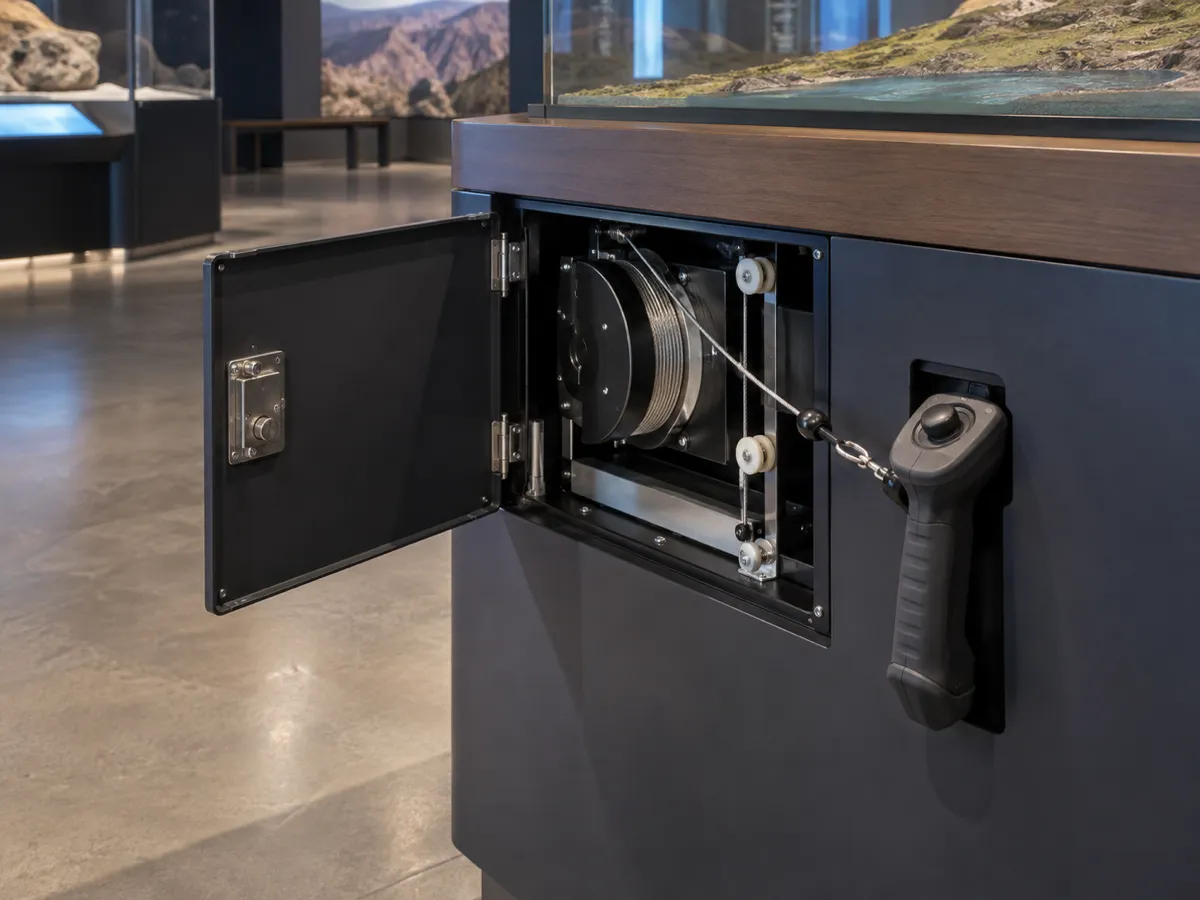
A cable spring can provide compact, repeatable motion control in a museum interactive exhibit controller when its force, travel, attachments and protection are designed around the complete assembly.
Explore cable springs for product information.
Quick answer
The retractor lets visitors move the controller within a defined zone and returns it to the display after use. Public interaction demands low pinch risk, concealed mounting and robust stops that protect the spring from abusive pulls. A production-ready design therefore balances user feel, reliable return or holding behavior, fatigue margin and safe mechanical stops.
Typical applications
- OEM museum interactive exhibit controller assemblies
- Compact handheld controller and tether return modules
- Custom mechanisms with limited installation space
- Prototype-to-production motion-control programs
Key design parameters
| Parameter | Why it matters |
|---|---|
| Moving load | Defines the force or torque needed at each position. |
| Travel and geometry | Determine spring working range, spool or pivot dimensions and preload. |
| Available envelope | Limits strip width, coil diameter, housing and attachment options. |
| Environment | Guides material, surface protection, lubricant and sealing choices. |
| Cycle-life target | Sets fatigue margin and validation duration. |
Failure modes to prevent
Common risks include cable cut or abrasion, hard snap-back, reel jams, mount loosening, connector strain and over-extension damage. These are often caused by excessive working travel, sharp attachment geometry, poor alignment, contamination or a production assembly whose friction differs from the prototype.
Prototype and life testing
Observe repeated short pulls as well as the full visitor reach. Record whether the controller returns to its intended resting position and whether its cable rubs the exhibit opening.
What to include in an RFQ
Provide controller mass, visitor reach, cable diameter, pull angles, target force, vandal resistance, over-travel stop, and daily cycles. Drawings or a 3D model of both spring attachments and the complete motion path help the engineering team avoid assumptions.
Custom development support
Discuss your application and arrange a private channel for detailed drawings.
FAQ
How is the spring size selected for a museum interactive exhibit controller?
Identify the controller mass, outlet location and expected pattern of visitor use. Separate a comfortable outward pull from the force needed to retrieve slack.
Can one cable spring design cover several product variants?
A shared reel needs review across the controller weights, cable reaches and outlet positions used by the exhibit; confirm return and wear with each relevant configuration.
Why are end stops important?
Check the enclosure stop and connector restraint under the permitted pull. Public-access safeguarding and the complete exhibit require their own review.