
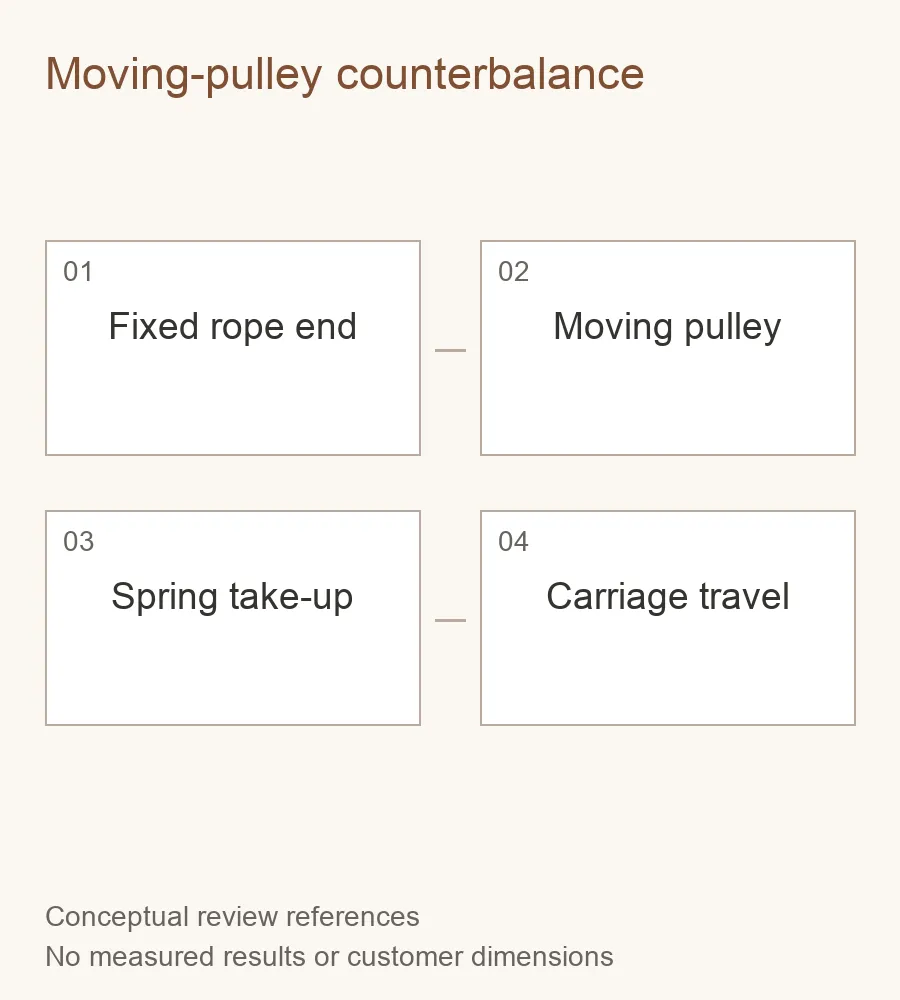
A pulley attached to the moving carriage changes both the force relationship and the spring travel. Start by drawing the rope path, rather than selecting a spring equal to the carriage weight. Counting pulleys is not enough: a fixed pulley that redirects a rope and a moving pulley supported by two rope legs do different jobs.
Follow the two distances
Mark one carriage position and track every point at a second position. Which rope lengths grow, which shorten, and which remain fixed? The spring-side displacement follows that length balance. In an ideal two-leg arrangement, the moving load can receive twice the rope tension while the spring-side travel is twice the carriage travel. That example assumes the usual geometry, equal tensions and negligible losses; it is not a specification for a real assembly.
The useful design question is whether the spring can cover the resulting movement inside its approved working interval. A compact carriage stroke can still demand considerable spring payout. Keep take-up, retained material and mechanical overtravel outside the interval used for normal operation.
Check what the ideal model leaves out
Pulley bearing resistance, rope bending and changing exit angles can make the measured tensions differ. Include the actual pulley and rope in the assembled review. Compare lifting and lowering at the same carriage positions; a single spring-side reading will not explain the effort at the handle.
Also mark the reaction at the rope's fixed end and at each pulley support. Reducing operator effort does not remove these structural loads.
For an initial enquiry, a simplified rope-path sketch with two labeled positions is more useful than an isolated weight value. Identify which pulley moves with the carriage and which support remains fixed. The spring supplier can then discuss output and working travel without inferring the mechanism from a photograph.

For the broader background, read Power Spring Stroke Conversion Through a Cable Spool.
Explore related spring information or discuss this mechanism with a non-confidential description.