
A removable tray or cassette creates at least two counterbalance cases: loaded and empty. The spring remains connected when the payload leaves. Selecting assistance only for the working load can therefore leave the empty carrier biased in the opposite direction.

Include removal in the motion sequence
Describe where the payload is inserted and removed. Does a mechanical support hold the carrier at that position? Can the user remove the load at an intermediate height? Those details determine which empty states the mechanism must tolerate.
List the parts that remain attached after removal. A carrier, handle and cable loop can still form a significant moving load. Conversely, treating an absent payload as though it remains installed can hide the largest upward imbalance.
Decide what changes with the load
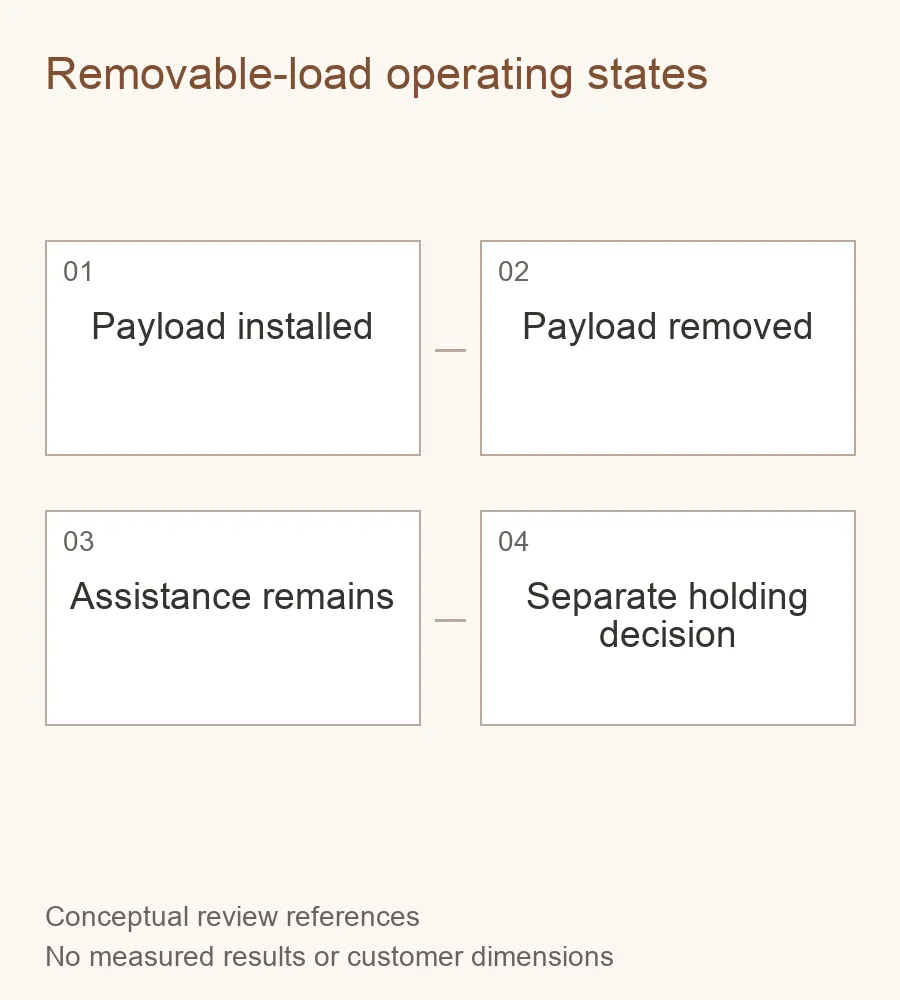
A fixed-output assist may be acceptable if the permitted effort band covers both states and a separate holding arrangement controls the carrier. Other concepts may need an adjustable assist or a restricted removal position. These are alternatives for an assembly review, not reasons to disconnect a loaded spring during normal use.
Write the loading and unloading requirements in operational terms. For example, specify where the carrier is retained while the cassette is transferred, and what movement is permitted after the cassette clears its supports. Do not substitute the vague instruction to keep a hand on it for a defined retention function.
Prototype checks should include the empty carrier, the permitted payload range and the actual removal sequence. Record initial movement and end-stop behavior, not just lifting effort. A product that feels balanced while loaded has answered only one part of the question.
For the broader background, read Variable Force Spring Design Changes After Load Growth.
Explore related spring information or discuss this mechanism with a non-confidential description.