
A reel may wind and unwind cable successfully when the moving end is free to turn, yet behave differently when both ends are rotationally restrained. The bench setup has then removed a constraint that exists in the product.
Preserve the end orientations
Record how each end is mounted and whether its orientation can change during normal use. A connector plugged into a fixed device is not equivalent to a loose connector hanging in the air. Mark the initial cable orientation where an approved observation method allows it.
Follow the intended cable route through a full permitted cycle. Identify any swivel or rotary interface and the function it actually provides. Do not assume that a rotating housing or guide removes twist from the cable itself.
Compare like with like
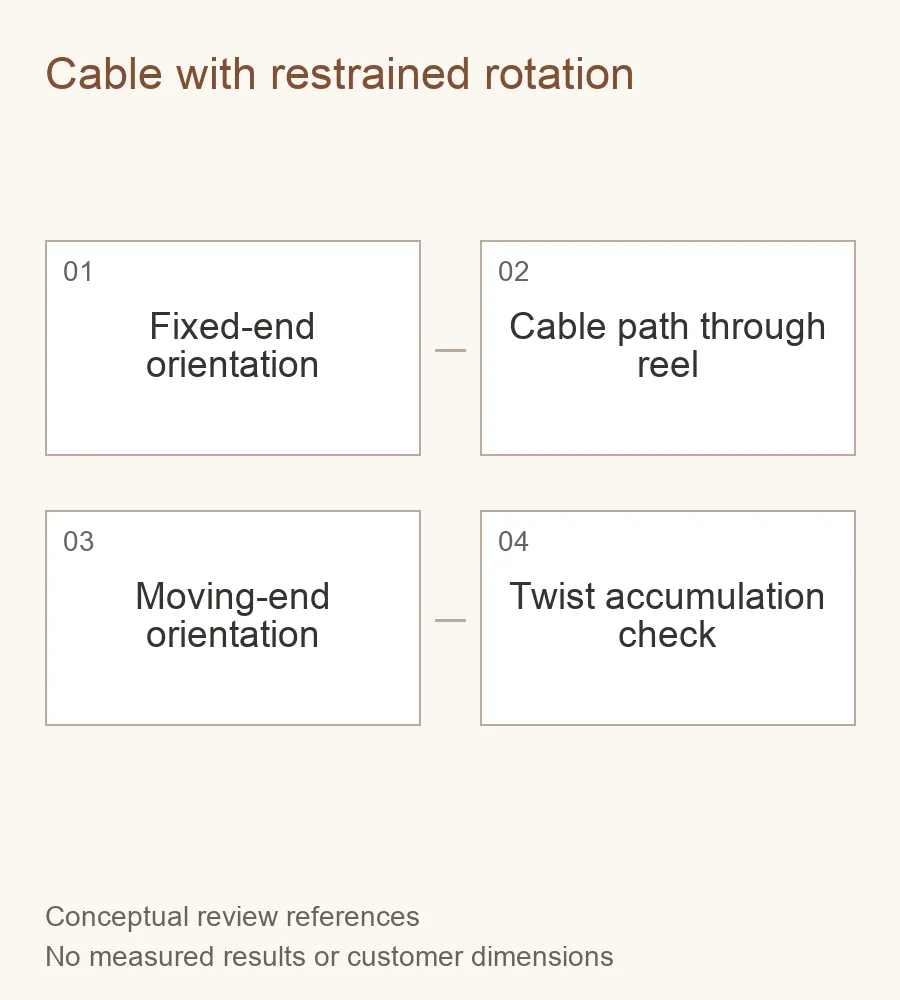
The qualification setup should reproduce the defined end constraints. Watch for changes in cable shape, side contact and return effort as cycles accumulate. These observations help identify a routing question, but they do not establish the cable's torsional rating.
Use the cable supplier's flex and torsion requirements. A stronger spring can force movement while increasing stress or contact, so completion alone is not sufficient acceptance evidence.
Keep the spring and cable evaluations connected but separate: the spring supplies the required torque, while the cable remains within its permitted mechanical conditions. The installation record should state both end orientations so that a later test does not accidentally substitute a free-turning end and conceal the original constraint.
For the broader background, read Cable Reel Cable Twist and Swivel Decisions.
Explore related spring information or discuss this mechanism with a non-confidential description.
Background reference: igus cable installation guidance. Component documentation does not qualify the complete mechanism.