
In a telescopic mast, several cable exits can move at once. Measuring only the height of the final tool misses the length changes between stages. The reel's required payout follows the complete route, not necessarily the mast's overall extension.
Make a position sequence
Draw the retracted state, each stage transition and the extended state. Give every guide or exit an identity and mark which mast member carries it. Then compare the cable length between consecutive points. Some spans may shorten while others grow.
Include the cable needed at a rotating or articulated tool. If that movement is permitted independently of mast extension, it creates additional route states. Do not hide the extra length inside an unexplained allowance.
Check where the cable can collect
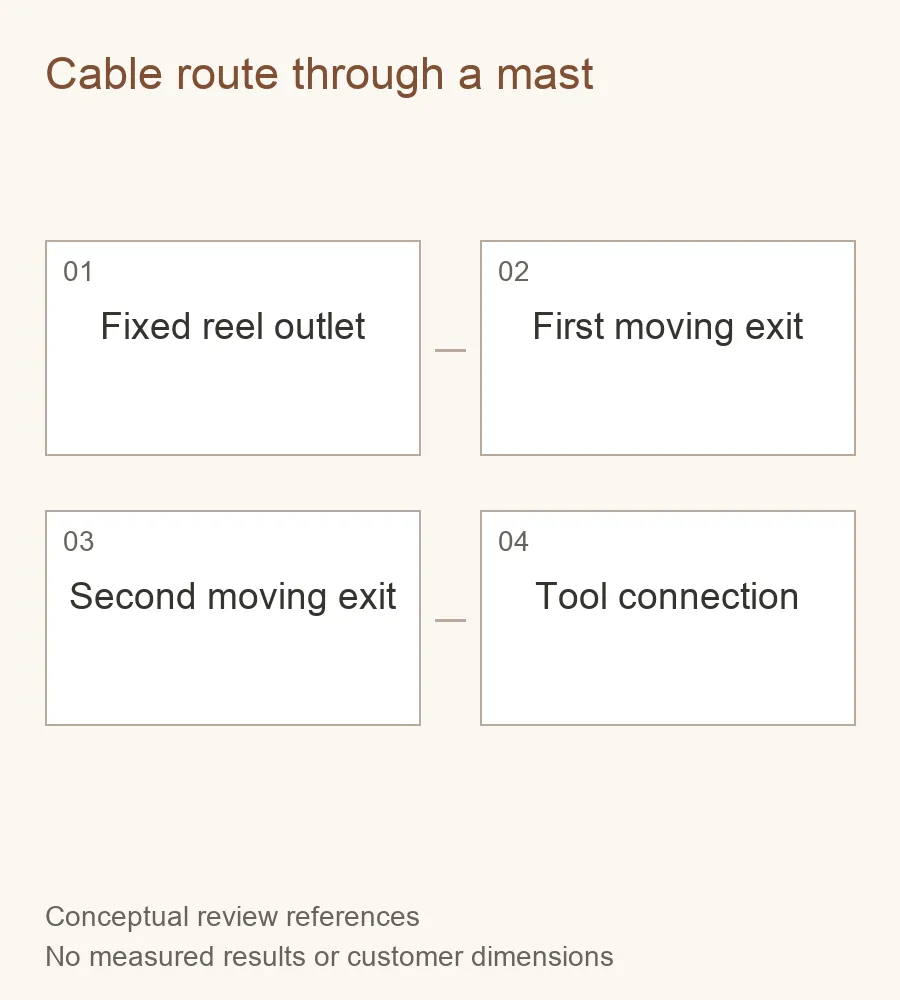
During retraction, a moving guide may return cable faster than the reel takes it up. Observe the spans where slack could meet a stage joint, pinch point or stop. Completing the mast stroke does not establish acceptable cable management.
The assembled review needs the final cable, guide arrangement and intended stage sequence. Hold the route constant when comparing spring options; otherwise a routing improvement can be misreported as a spring improvement.
A compact enquiry can use a route diagram with guide identities and position pairs. It need not expose the mast's detailed construction, but it must show the moving exits that determine payout and clearance.
For the broader background, read Cable Retraction Stroke After Connector Replacement.
Explore related spring information or discuss this mechanism with a non-confidential description.