
A drain opening can be clear when a retraction module is open for inspection but obstructed when its cable, cover or moving attachment reaches another position. Drainage should be checked against the movement envelope, not just the static housing drawing.

Put the opening on the motion sketch
Show the drain and nearby moving parts at parked, intermediate and extended states. Include any protective sleeve or cable boot that changes shape through the stroke. A centerline does not represent the space occupied by a flexible bundle.
Keep the actual installed orientation in the record. A drain that is low on a bench may not be low in the product.
Review the intended liquid route
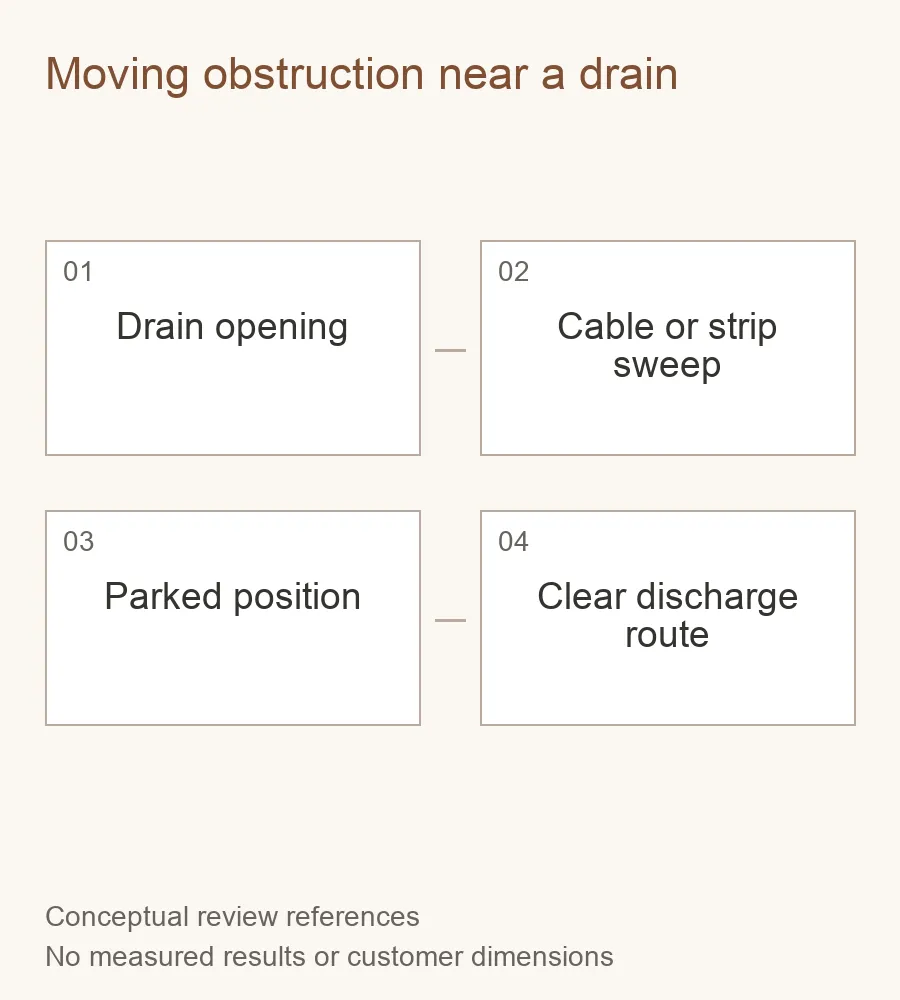
Identify where liquid is expected to leave and what regions remain protected. The drain path is not proof of an enclosure rating or material compatibility; those require their own component and product evidence.
Use the equipment designer's approved evaluation rather than pouring unspecified liquid into a loaded module. Observations should identify the configuration and position being assessed.
If a clearance change is proposed, recheck cable guidance and spring travel too. Moving a guide to expose a drain can create another contact point elsewhere. Accept the final route as part of the complete installed arrangement rather than treating the hole alone as a completed drainage design.
For the broader background, read Spring Strip Storage Packaging and Moisture Control.
Explore related spring information or discuss this mechanism with a non-confidential description.