
A nearly constant spring force does not mean constant mechanical power. Power depends on how quickly movement occurs as well as on the force or torque transmitted. A stationary loaded spring can exert force without delivering mechanical work at that instant.

Keep the quantities separate
For force acting along a movement, instantaneous mechanical power is force multiplied by velocity. For rotary motion, it is torque multiplied by angular velocity. Direction and the selected measurement boundary must be consistent; these are relationships between quantities, not published performance values for a product.
Energy over a stroke is another quantity. It depends on the force integrated over displacement, or torque over angle. The same movement completed slowly and quickly can involve a similar ideal mechanical energy transfer while having different power histories.
Apply the distinction to a return mechanism
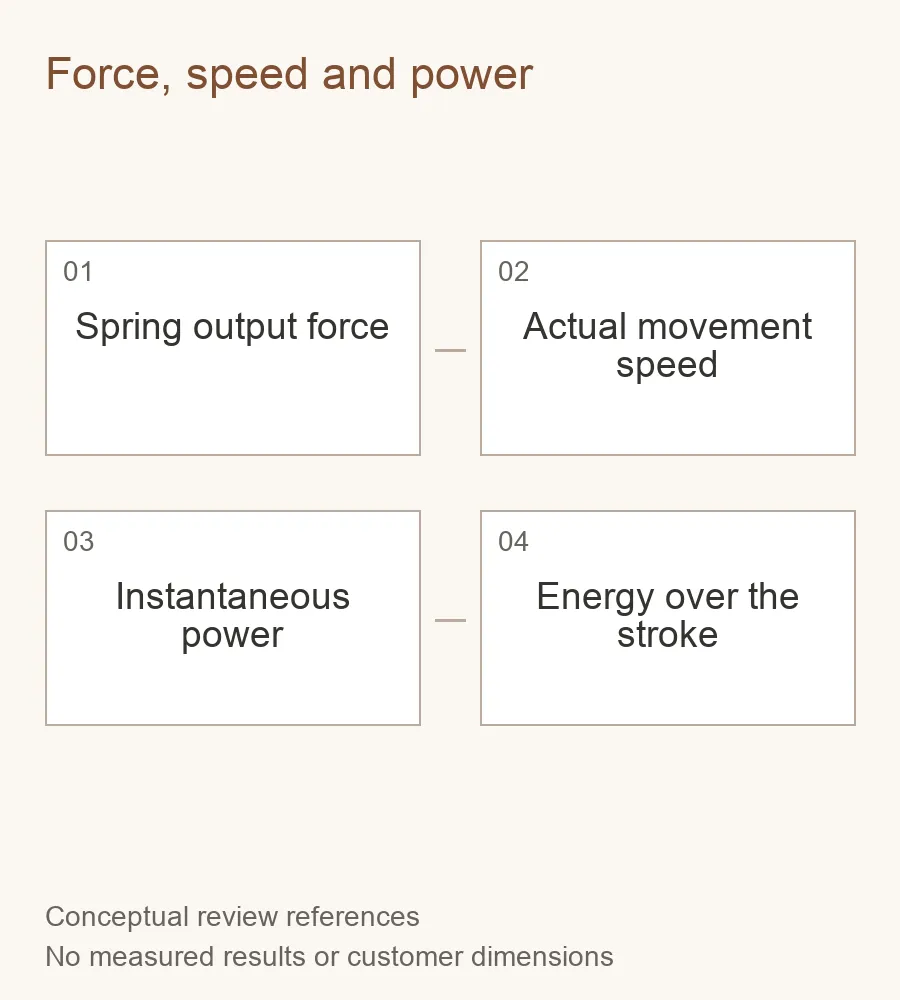
A return spring's force curve does not establish the return speed. Load, inertia, friction, transmission and any control element influence the movement. Consequently, calling a spring constant force does not describe the power delivered during an uncontrolled release.
If a requirement concerns motion time, peak power or controlled speed, specify that quantity at the relevant interface and evaluate the complete arrangement. Do not infer it from a flat static force plot.
For a component discussion, provide the required force or torque profile and the intended motion context separately. This avoids using force, energy and power as interchangeable labels when they lead to different design and measurement questions.
For the broader background, read Power Spring Energy: Torque Curve Area Rather Than Peak.
Explore related spring information or discuss this mechanism with a non-confidential description.