
Returning only a spring can remove the evidence needed to understand an assembly problem. A damaged attachment, rubbing guide or changed coupling may matter as much as the spring. Decide the inspection boundary before separating parts.

Agree the question first
Identify the observation to be investigated and the references needed to interpret it. If contact or fit is involved, ask whether the relevant mating component, its revision and its installed orientation should accompany the sample.
Photographs and records may preserve some relationships, but they should not be assumed to replace every physical interface. Conversely, sending an entire machine is not automatically necessary for a focused component question.
Preserve condition and identity
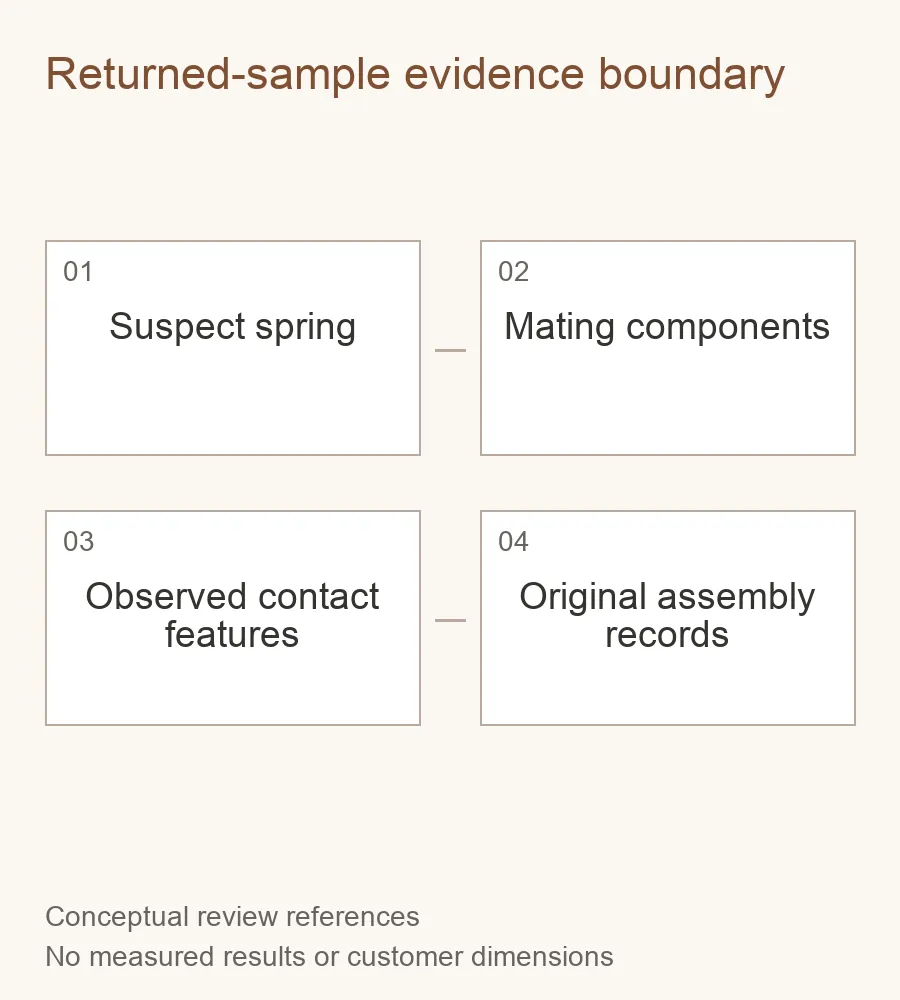
Use the product's approved handling procedure for any loaded or restrained assembly. This article is not an instruction to dismantle a spring module. Agree what may be separated and what must remain intact with the responsible supplier and equipment owner.
Keep part identity, exposure history and the original arrangement linked to the returned items. Avoid cleaning, adjusting or discarding a potentially relevant contact feature before the inspection plan says how it will be treated.
The return record should list included items and important omissions. This allows the investigator to state what the received evidence can support rather than issuing an apparently complete spring conclusion from an incomplete assembly boundary.
For the broader background, read Spring Failure Investigation with Part Identity.
Explore related spring information or discuss this mechanism with a non-confidential description.