
Illustrative application image. This image is not evidence of a customer installation or a validated spring assembly.
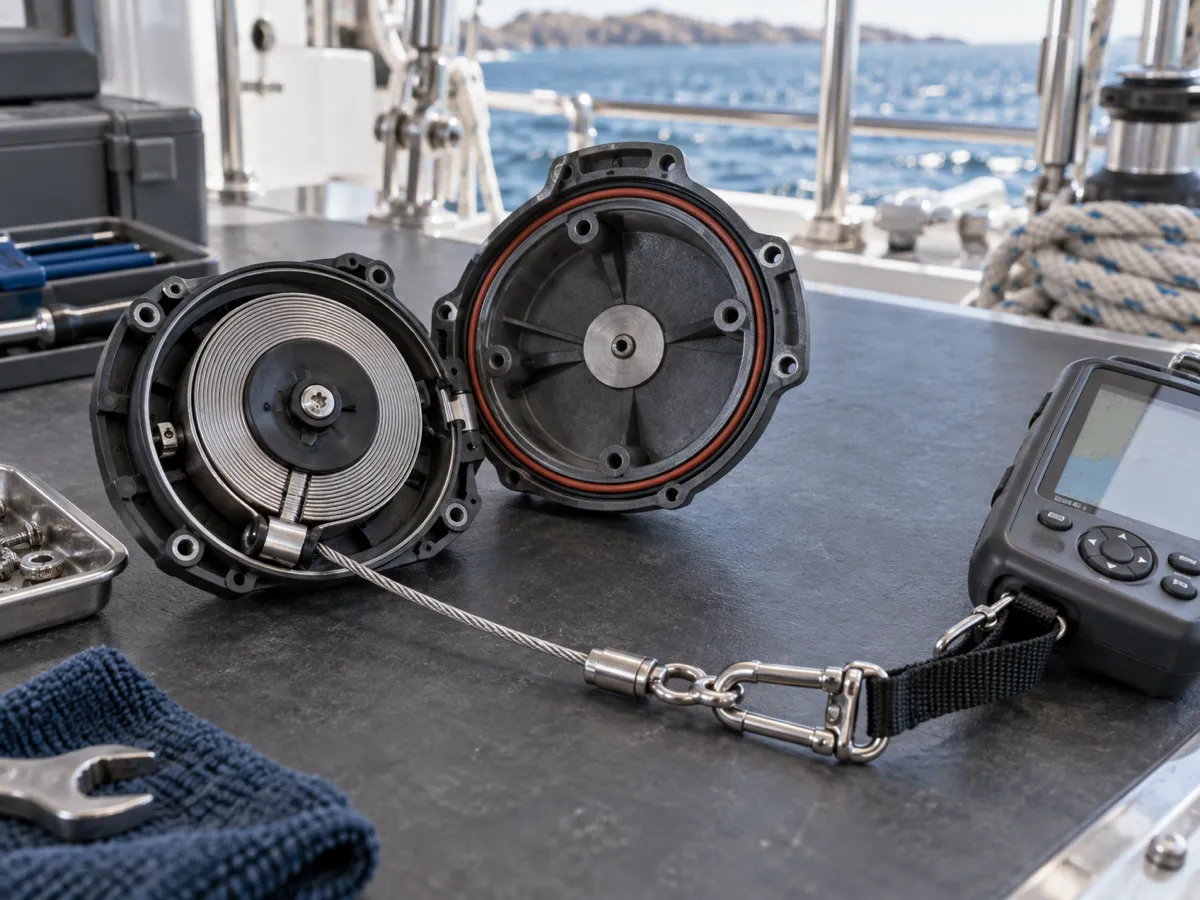
A cable spring can provide compact, repeatable motion control in a marine instrument safety tether when its force, travel, attachments and protection are designed around the complete assembly.
Explore cable springs for product information.
Quick answer
A corrosion-resistant retractor keeps a handheld navigation or inspection instrument attached to the vessel while allowing normal use. The spring, cable, fasteners and housing must be evaluated together for salt, spray and shock loads. A production-ready design therefore balances user feel, reliable return or holding behavior, fatigue margin and safe mechanical stops.
Typical applications
- OEM marine instrument safety tether assemblies
- Compact handheld marine instrument and stainless tether return modules
- Custom mechanisms with limited installation space
- Prototype-to-production motion-control programs
Key design parameters
| Parameter | Why it matters |
|---|---|
| Moving load | Defines the force or torque needed at each position. |
| Travel and geometry | Determine spring working range, spool or pivot dimensions and preload. |
| Available envelope | Limits strip width, coil diameter, housing and attachment options. |
| Environment | Guides material, surface protection, lubricant and sealing choices. |
| Cycle-life target | Sets fatigue margin and validation duration. |
Failure modes to prevent
Common risks include corrosion, water ingress, cable bird-caging, weak return, clip failure and spring damage after shock loading. These are often caused by excessive working travel, sharp attachment geometry, poor alignment, contamination or a production assembly whose friction differs from the prototype.
Prototype and life testing
Record return with the instrument attached, including the permitted cable exit angles and the exposure condition. Inspect the cable and connector after the agreed wet or salt exposure; a dry bench return does not establish marine suitability.
What to include in an RFQ
Provide instrument mass, tether length, cable construction, pull force, salt exposure, sealing target, mounting orientation, over-travel load, and life target. Drawings or a 3D model of both spring attachments and the complete motion path help the engineering team avoid assumptions.
Custom development support
Discuss your application and arrange a private channel for detailed drawings.
FAQ
How is the spring size selected for a marine instrument safety tether?
Describe the instrument mass, tether length and mounting location. Ask which exposed materials and interfaces need review for the actual environment, without assuming a generic corrosion rating.
Can one cable spring design cover several product variants?
Compare instrument mass, attachment and exposure for each variant. A different tether or mounting angle changes the assembled return requirement and needs its own evidence.
Why are end stops important?
Check the retained tether and independent payout stop at the allowed extension. Do not use the spring or an electrical connector as an assumed overload stop.