
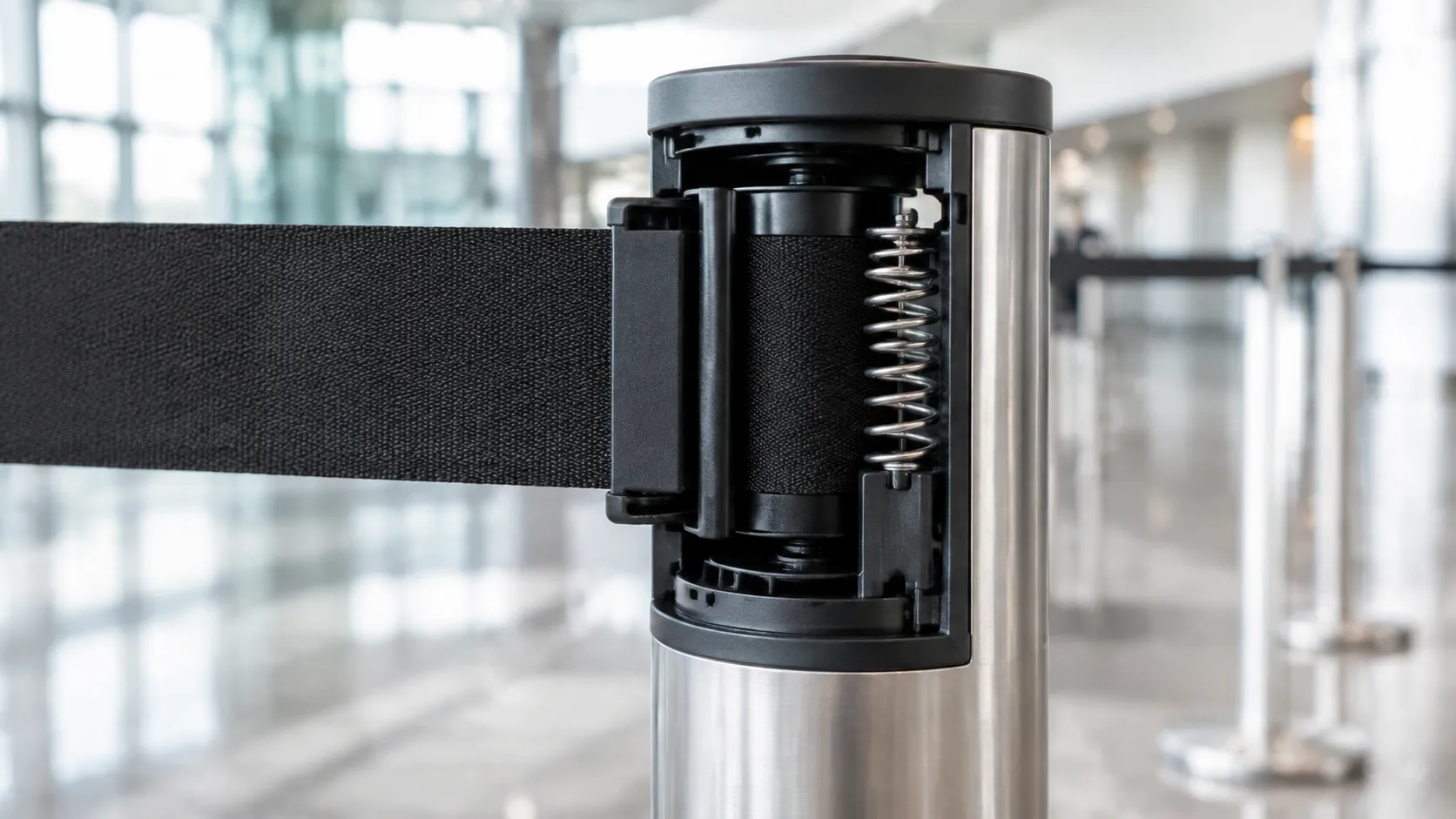
A power spring retracts the webbing in a crowd-control or safety barrier cassette by rotating the spool after the belt is disconnected from its receiver.
For product teams comparing compact return and counterbalance options, the spring should be evaluated as part of the full mechanism. Shenzhen Leading Spring develops custom power springs around the required load, motion, space, attachments, environment, and production target.
Quick answer: when is this spring solution suitable?
A power spring retracts the webbing in a crowd-control or safety barrier cassette by rotating the spool after the belt is disconnected from its receiver. It is most suitable when the product needs repeatable mechanical force in a compact package and the spring can be protected from over-travel, sharp edges, and misalignment.
Where this mechanism is used
- Queue-control stanchions
- Warehouse aisle barriers
- Checkout lane closures
- Portable exhibition barriers
How the spring works in the assembly
Barrier webbing is light, but the extension can require many spool turns. The spring needs sufficient reserve torque for complete return while limiting hook acceleration. Spool flange design, belt layering, outlet friction, and end stops are as important as spring torque for reliable public use.
Key design parameters
| Parameter | Why it matters |
|---|---|
| Belt length and width | Set spool capacity and working turns. |
| Hook mass | Influences return impact and user safety. |
| Spool core diameter | Affects pull force and torque demand. |
| Maximum extension | Defines fatigue exposure and stop position. |
| Public-use cycles | Drive durability and abuse testing. |
Common failure modes to prevent
Likely faults include belt edge wear, uneven stacking, weak final return, spring end pullout, sudden hook acceleration, and damage from users extending beyond the intended limit. A robust stop should carry over-travel load before it reaches the spring attachment.
Recommended prototype and life testing
Measure pull force at quarter points, return time, and hook speed near the outlet. Cycle at several belt angles, include repeated maximum-extension events, and perform reasonable abuse tests on the hook and receiver. Inspect webbing edges, spool flanges, stops, and spring ends.
What to include in an RFQ
Provide belt length, width, thickness and mass, hook weight, spool dimensions, maximum turns, desired pull force, return-time limit, housing size, mounting orientation, and target cycles.
Custom spring development support
Shenzhen Leading Spring supports application review, custom spring design, prototypes, and production. Final force, torque, material, dimensions, and attachment details should be confirmed from the customer’s drawings and mechanism tests. To discuss a new project, contact our spring engineering team.
FAQ
Why should the hook speed be limited?
A fast-returning hook can strike the housing or nearby surfaces. Torque, friction, damping, and user instructions may all contribute to control.
Can one spring cover different belt lengths?
Only when each length remains within the spring's validated working turns and force window.
What protects the spring from over-extension?
A dedicated mechanical stop or belt stop should absorb over-travel before the spring end is overloaded.