
A spring-assisted carriage may carry more of its service cable at one height than another. The payload has not changed, but the supported cable length and loop shape have. That can make a constant spring contribution feel less balanced near one end of travel.

Include the hanging services
Show the cable or hose attachment at the carriage, the fixed support and the loop shape at low, middle and high positions. Identify which sections are supported by the frame and which load the carriage. A bill-of-materials cable mass does not tell you how that mass is distributed during movement.
Distinguish weight from bending resistance. A flexible loop can both add a gravitational load and oppose motion through its stiffness. Changing loop length or material may alter both contributions.
Review routing before changing the spring
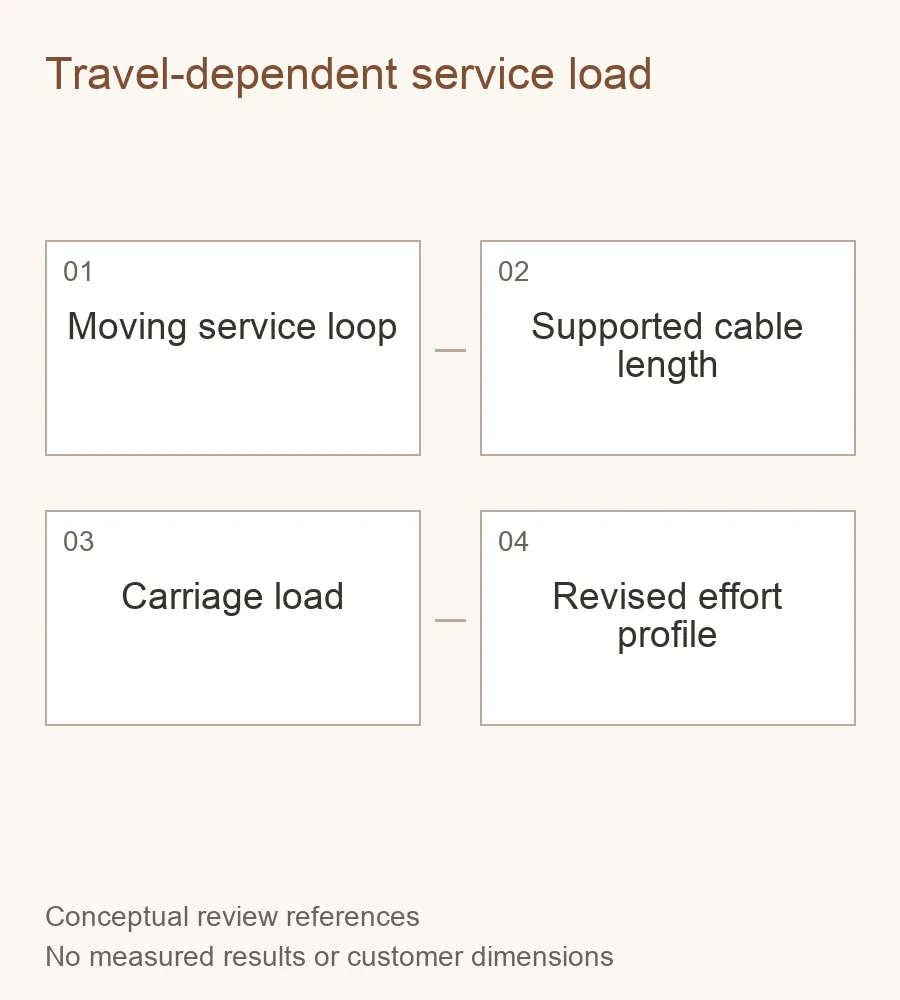
Compare effort with the production service route installed. If the result differs from a bare-carriage test, retain both configurations in the record. Do not simply average the two results into a spring specification.
A support or routing change may reduce the varying load, but it must still preserve cable bend limits, strain relief and the required motion envelope. Shortening a loop to reduce weight can introduce a tighter bend or a pull on a connector.
If the varying load remains part of the design, provide the spring reviewer with a position-dependent requirement rather than a single carriage weight. Mark which contribution was measured and which was estimated. The useful outcome is an assistance profile compatible with the real services, not an apparently balanced carriage whose cables were absent during qualification.
For the broader background, read Cable Reel Retraction Against Cable Stiffness.
Explore related spring information or discuss this mechanism with a non-confidential description.