
A closed spring module may need an external interface for controlled winding during assembly or service. The interface must communicate the winding reference and the supported state; access to a shaft alone is not an installation method.

Define the permitted operation
State who performs the operation, which assembly condition it requires and what keeps the output restrained. Identify the approved drive feature and the direction from a named viewing side. A reversible socket can otherwise make two opposite actions look equally plausible.
Keep any assembly-only rotation separate from the normal operating interval. The winding record should connect the module identity to its starting reference and final approved setting.
Plan how the reference is confirmed
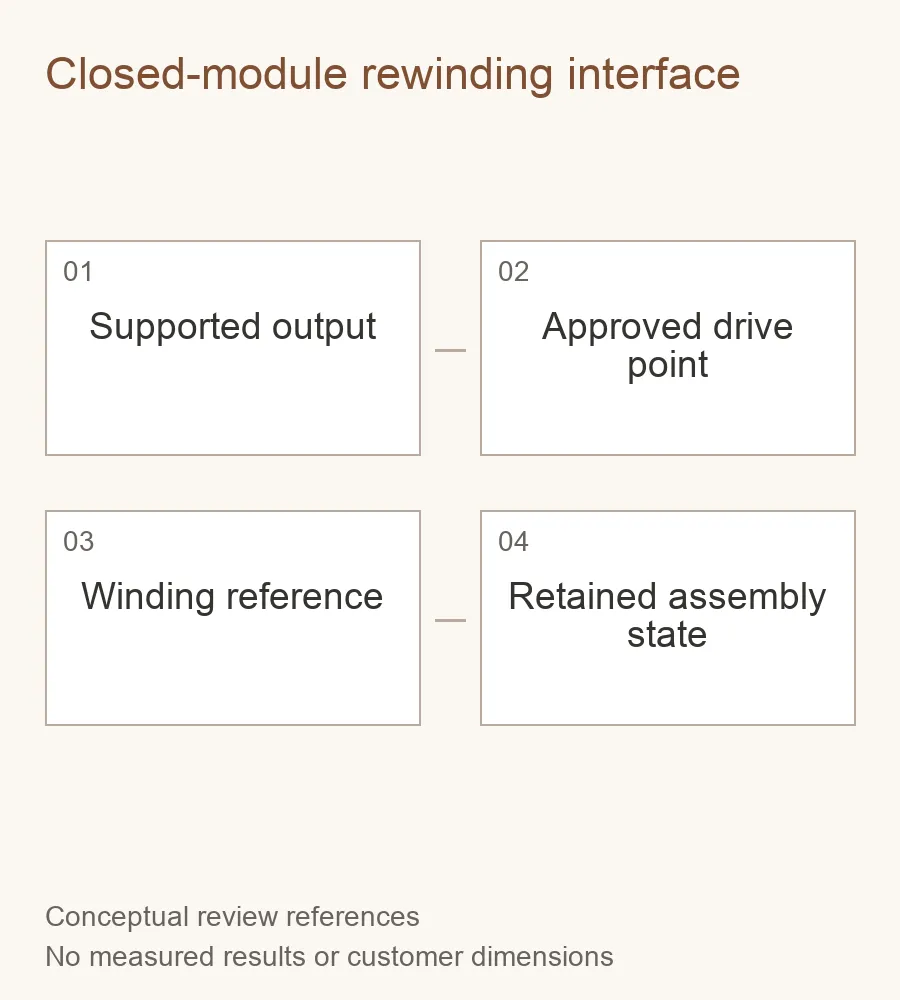
Decide whether the setting is verified through turns, a mechanical reference, torque at a defined position or a combination specified by the module designer. The public article does not establish those values. They belong in the controlled assembly instructions.
Also define the response when the reference is lost. Continuing to wind until the mechanism feels right is not a repeatable recovery method and can create an unknown stored-energy state.
A serviceable design provides an identifiable interface without inviting users to open the module or release internal restraints. The final review should connect access, tools, support, reference and verification. Keep this record with the service documentation rather than relying on an unexplained arrow molded into a cover.
For the broader background, read Power Spring Service Replacement at a Defined Reference State.
Explore related spring information or discuss this mechanism with a non-confidential description.