
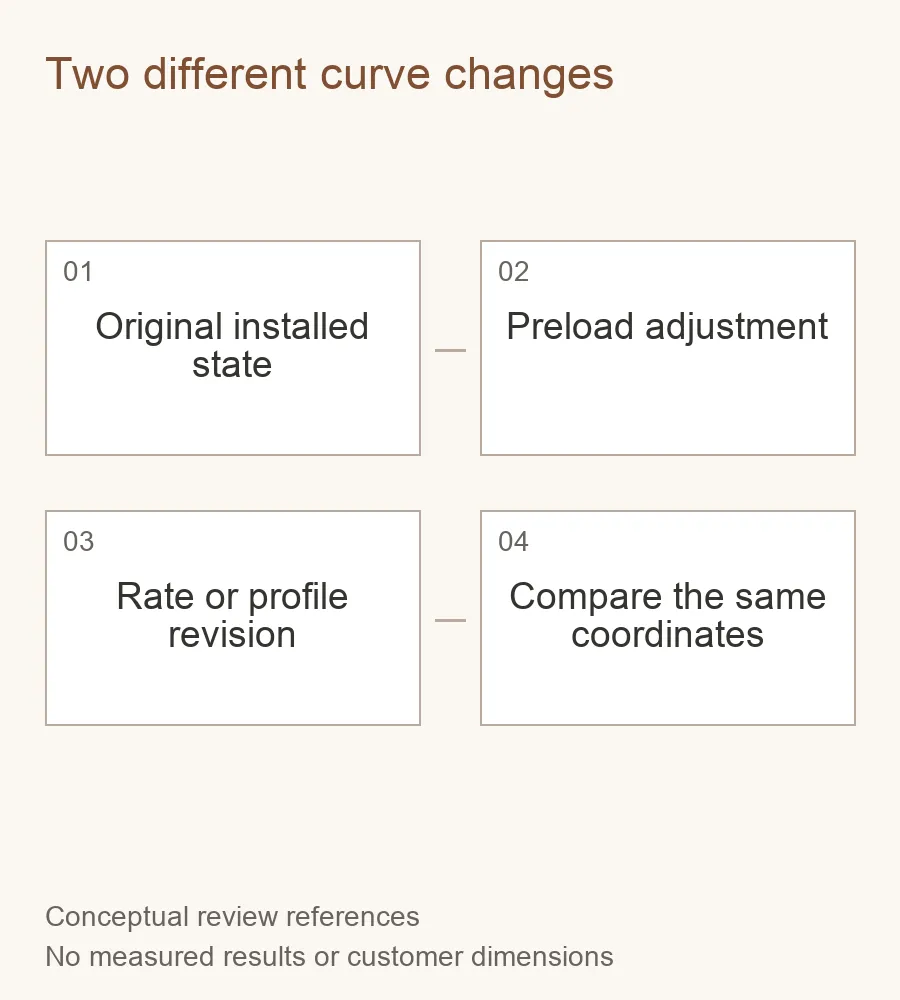
Moving the installed starting state and changing a spring's force-displacement characteristic are different revisions. Both can change the force at one operating point, so a single-point comparison may not reveal which change produced the result.
Compare more than the starting value
Record the original and revised installed states, then compare output at matching physical positions. Keep the component identity and adjustment setting with each trace.
A preload change can shift which part of a component's characteristic is used during operation. It should not automatically be described as a pure vertical offset for every spring family or nonlinear arrangement. The actual geometry and curve determine the effect.
Preserve the operating interval
Check the resulting travel or rotation limits as well as the desired force. An adjustment that improves starting effort can consume reserved movement or change the load at the other end.
If a different component profile is proposed, document it as a component revision rather than an installation adjustment. The associated dimensions, fit and qualification evidence may also need review.
The useful requirement is the accepted response through the intended interval, with the means of achieving it identified. This prevents two apparently similar starting-force results from being treated as equivalent even though they use different spring states and leave different margins elsewhere in the mechanism.
For the broader background, read Power Spring Preload Defined by Turns and Torque.
Explore related spring information or discuss this mechanism with a non-confidential description.