
A force-versus-position plot can be wrong even when both instruments measure correctly. If force and encoder samples refer to different moments during motion, a peak can be assigned to the wrong position or a local feature can appear displaced.

Establish the time relationship
Record how each channel is acquired, its timestamp source and any known acquisition or processing delay. Two files beginning at zero do not necessarily share the same zero event.
Identify a reference event observable in the relevant records through an approved test method. Retain the original timestamps and document any alignment applied afterward. Do not shift traces until they look similar and then present the result as an independently established correspondence.
Preserve motion direction and gaps
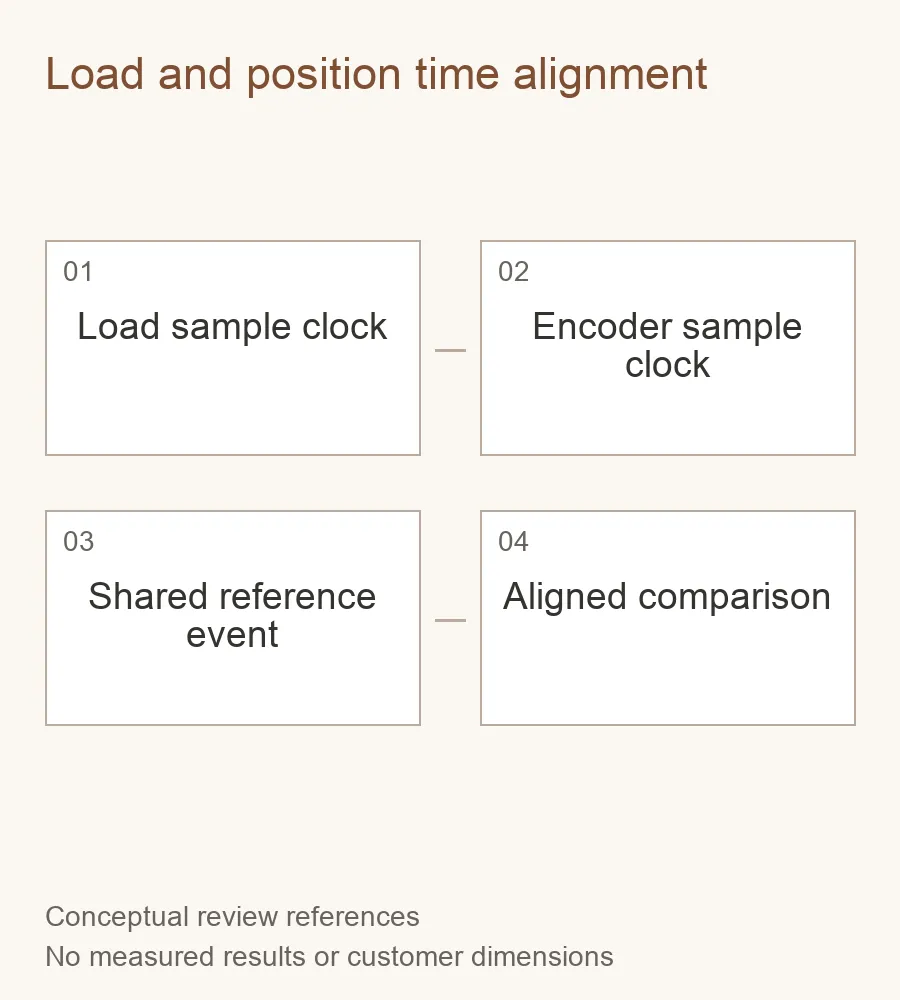
Position alone may not identify a unique time when the mechanism reverses or pauses. Keep direction and sequence with the samples. A repeated position during return is not interchangeable with the earlier forward pass.
Record missing samples, clock resets and pauses. Interpolating across an unknown interval can create a plausible-looking curve without supporting evidence.
The test report should state how synchronized data were obtained and what uncertainty remains in the relationship. This is distinct from encoder resolution or load-cell accuracy. For spring acceptance, compare the required quantities only after the time-to-position mapping is defined well enough for the decision being made.
For the broader background, read Spring Test Results Change with Sensor Alignment.
Explore related spring information or discuss this mechanism with a non-confidential description.
Background reference: US Digital encoder reference. Component documentation does not qualify the complete mechanism.