
Flexible bellows can add resistance that changes with their fold state. A return that works with the bellows removed may not represent the installed mechanism. The spring target should account for the approved protective arrangement, not an unprotected test axis.
Record the fold geometry
Identify the bellows version, fixed and moving ends, and orientation. Show its state at several travel positions. Folds can contact one another or surrounding structure before the mechanism reaches its intended endpoint.
Keep any pressure or airflow condition that the product specifies in the setup record. Do not assume the bellows is mechanically neutral simply because it is flexible.
Compare protection and motion together
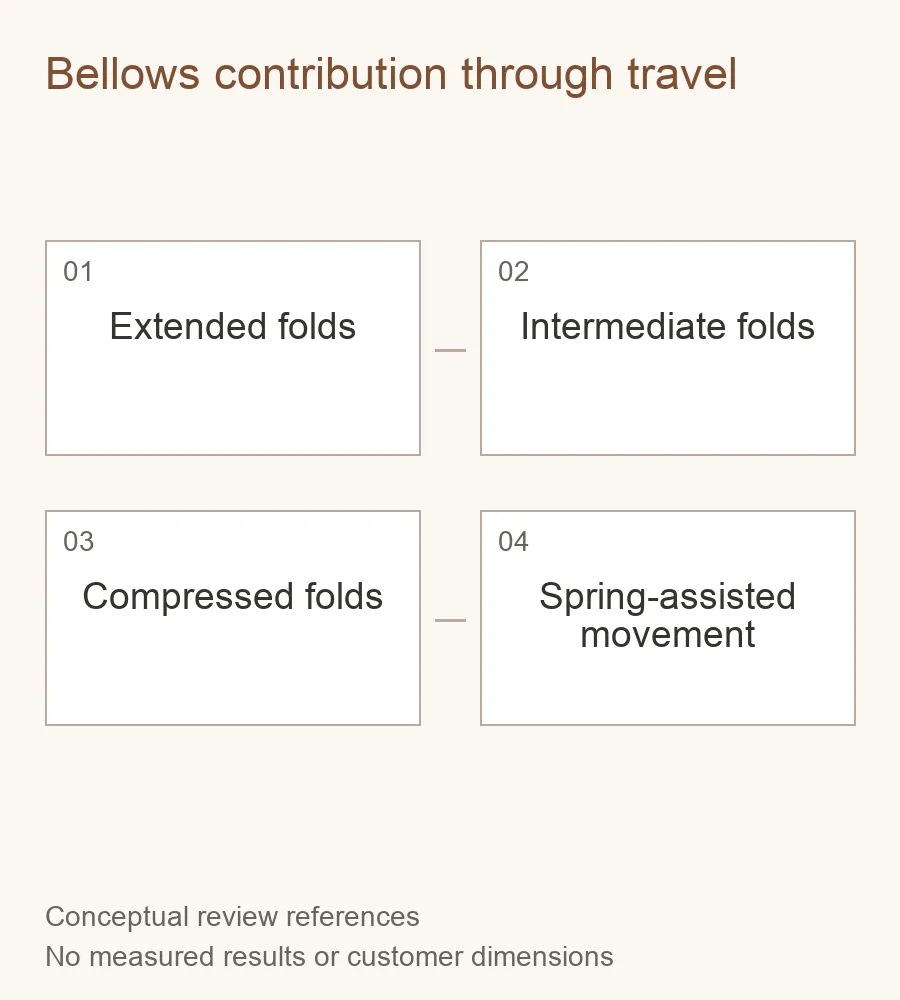
Observe whether resistance grows gradually, appears at a particular fold position or changes after a pause. Record the corresponding attachment position and direction. These patterns guide a bellows and routing review; they do not by themselves identify a defective spring.
A controlled comparison without the bellows may help isolate a contribution only when performed in an approved engineering setup. It should not become an operating recommendation to remove protection.
After a bellows or mounting revision, assess clearance and return across the required stroke. More spring force can force the assembly through contact while increasing wear. The accepted configuration should preserve both the intended protection and the defined movement.
For the broader background, read Cable Reel Retraction Against Cable Stiffness.
Explore related spring information or discuss this mechanism with a non-confidential description.