
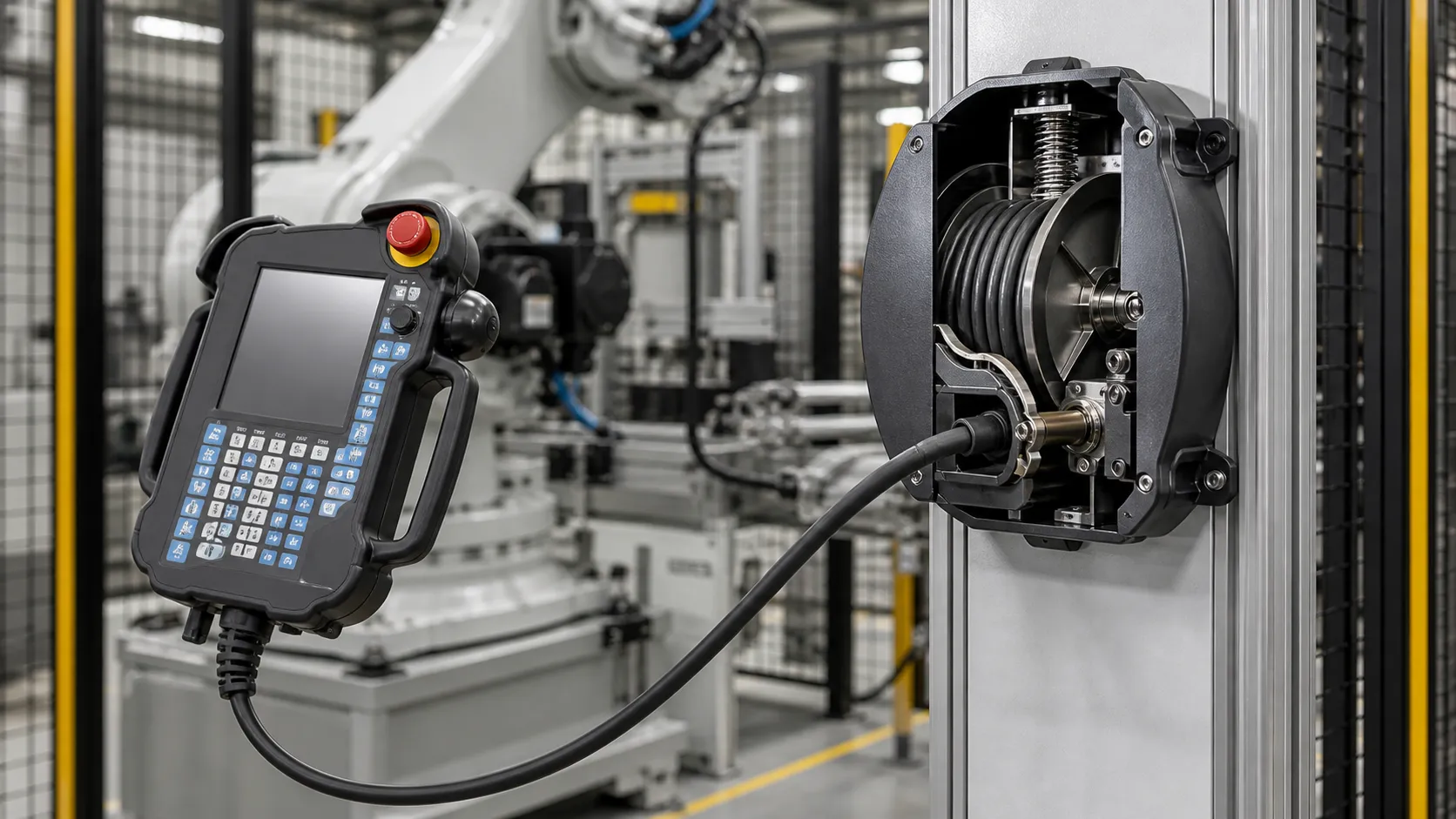
A cable spring retractor can keep robot teach pendant cable off the floor while allowing an operator to pull the pendant to the required work position with controlled resistance.
For product teams comparing compact return and counterbalance options, the spring should be evaluated as part of the full mechanism. Shenzhen Leading Spring develops custom cable springs around the required load, motion, space, attachments, environment, and production target.
Quick answer: when is this spring solution suitable?
A cable spring retractor can keep robot teach pendant cable off the floor while allowing an operator to pull the pendant to the required work position with controlled resistance. It is most suitable when the product needs repeatable mechanical force in a compact package and the spring can be protected from over-travel, sharp edges, and misalignment.
Where this mechanism is used
- Industrial robot teach pendants
- CNC handheld control panels
- Machine setup terminals
- Portable operator stations
How the spring works in the assembly
Teach pendant cables are heavier and often more flexible than scanner tethers. The design must manage cable mass without pulling the pendant from the operator's hands or loading the emergency-stop enclosure. Routing should preserve the manufacturer's minimum bend radius and avoid introducing a new snag point near the workcell.
Key design parameters
| Parameter | Why it matters |
|---|---|
| Pendant and cable mass | Define support and retraction demand. |
| Operator reach zone | Sets usable extension length. |
| Minimum bend radius | Protects conductors and shielding. |
| Mounting height | Changes hanging load and return behavior. |
| Workcell environment | Affects protection from oil, dust, and abrasion. |
Common failure modes to prevent
Potential issues include high operator drag, cable twist, connector strain, uncontrolled pendant movement, retractor jams, and abrasion at the outlet. A spring retractor is a cable-management component, not a safety-rated support unless the complete system is specifically engineered and certified for that purpose.
Recommended prototype and life testing
Map the actual operator reach envelope and measure pull force at working positions. Cycle representative movements, including side pulls, rotation, and parking. Verify emergency-stop access, cable integrity, mounting security, and clearance from robot motion throughout the risk-assessed cell layout.
What to include in an RFQ
Provide pendant mass, cable construction and length, connector details, reach envelope, mounting height, preferred parking position, target pull force, environmental exposure, working cycles, and applicable machine-safety constraints.
Custom spring development support
Shenzhen Leading Spring supports application review, custom spring design, prototypes, and production. Final force, torque, material, dimensions, and attachment details should be confirmed from the customer’s drawings and mechanism tests. To discuss a new project, contact our spring engineering team.
FAQ
Can a retractor carry the full pendant weight?
It may offset part of the cable or pendant load, but the safe arrangement depends on mounting, force, connectors, and the machine risk assessment.
How do you prevent cable twist?
Use suitable routing, reel alignment, outlet guides, and, where appropriate, swiveling features; validate the actual pendant motion.
Can the retractor be mounted overhead?
Yes, if the pull direction, fall risk, mounting strength, cable bend radius, and operator ergonomics are all reviewed.