
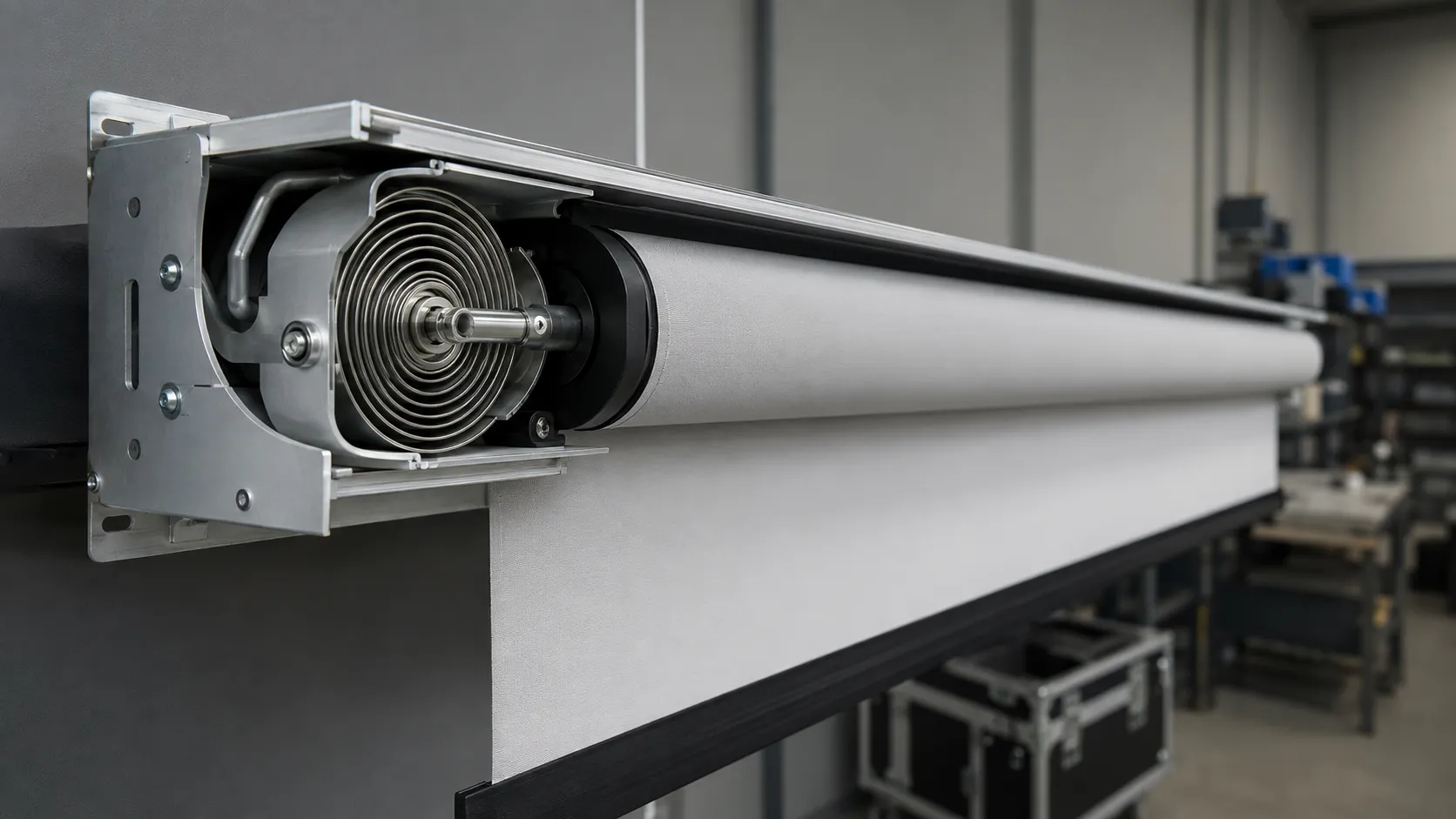
A power spring inside a projection screen roller stores energy as the screen is pulled down and supplies return torque when the latch or brake is released.
For product teams comparing compact return and counterbalance options, the spring should be evaluated as part of the full mechanism. Shenzhen Leading Spring develops custom power springs around the required load, motion, space, attachments, environment, and production target.
Quick answer: when is this spring solution suitable?
A power spring inside a projection screen roller stores energy as the screen is pulled down and supplies return torque when the latch or brake is released. It is most suitable when the product needs repeatable mechanical force in a compact package and the spring can be protected from over-travel, sharp edges, and misalignment.
Where this mechanism is used
- Manual pull-down projection screens
- Portable presentation screens
- Retractable classroom displays
- Compact privacy and divider screens
How the spring works in the assembly
The spring must lift the screen fabric and bottom bar while overcoming bearing and guide friction. Roller diameter changes the relationship between spring torque and vertical pull. A controlled return is essential because a fast bottom bar can strike the cassette, while low end-of-travel torque may leave the fabric hanging.
Key design parameters
| Parameter | Why it matters |
|---|---|
| Fabric and bottom-bar mass | Set lifting torque requirement. |
| Screen drop | Defines roller turns and stored energy. |
| Roller diameter | Converts torque into vertical force. |
| Latch or brake drag | Changes required reserve torque. |
| Return-time target | Guides torque and damping decisions. |
Common failure modes to prevent
Common symptoms are incomplete roll-up, telescoping fabric, wrinkles, spring chatter, broken attachments, and hard impact at the top. Misaligned brackets or an uneven bottom bar can appear to be a spring problem but should be corrected mechanically.
Recommended prototype and life testing
Measure pull force and return time with the production fabric and bottom bar. Test repeated full and partial drops, latch release, bracket misalignment tolerance, and elevated-temperature storage. Observe tracking at both roller ends and inspect spring containment after cycling.
What to include in an RFQ
Share screen width, drop, fabric and bar mass, roller inner diameter, cassette space, number of roller turns, target pull force, desired return time, latch type, orientation, and cycle-life requirement.
Custom spring development support
Shenzhen Leading Spring supports application review, custom spring design, prototypes, and production. Final force, torque, material, dimensions, and attachment details should be confirmed from the customer’s drawings and mechanism tests. To discuss a new project, contact our spring engineering team.
FAQ
Can a spring retract a wide projection screen evenly?
Yes, when roller stiffness, bearing alignment, fabric attachment, and torque are designed together. Spring torque alone cannot prevent roller deflection.
Why does the screen snap upward?
Return torque may be too high or damping too low, especially near stowage where moving mass and friction change.
Can the spring fit inside the roller tube?
Often yes. The available inner diameter, shaft arrangement, spring envelope, and attachment method determine feasibility.