
The force needed to insert a connector should not automatically be carried by a reel spring. Retraction, docking and electrical mating are different actions. A spring that pulls harder may make docking awkward without providing a controlled insertion load path.

Identify what supports insertion
Show where the connector body contacts its dock and where the user applies force. Trace that force through the dock, housing and mounting. The cable termination and spring should not be assumed to provide the structural reaction for a mating operation.
Use the connector supplier's mechanical requirements for its intended mating process. Reel return force is not a substitute for those limits or for alignment of the mating parts.
Review the transition into the dock
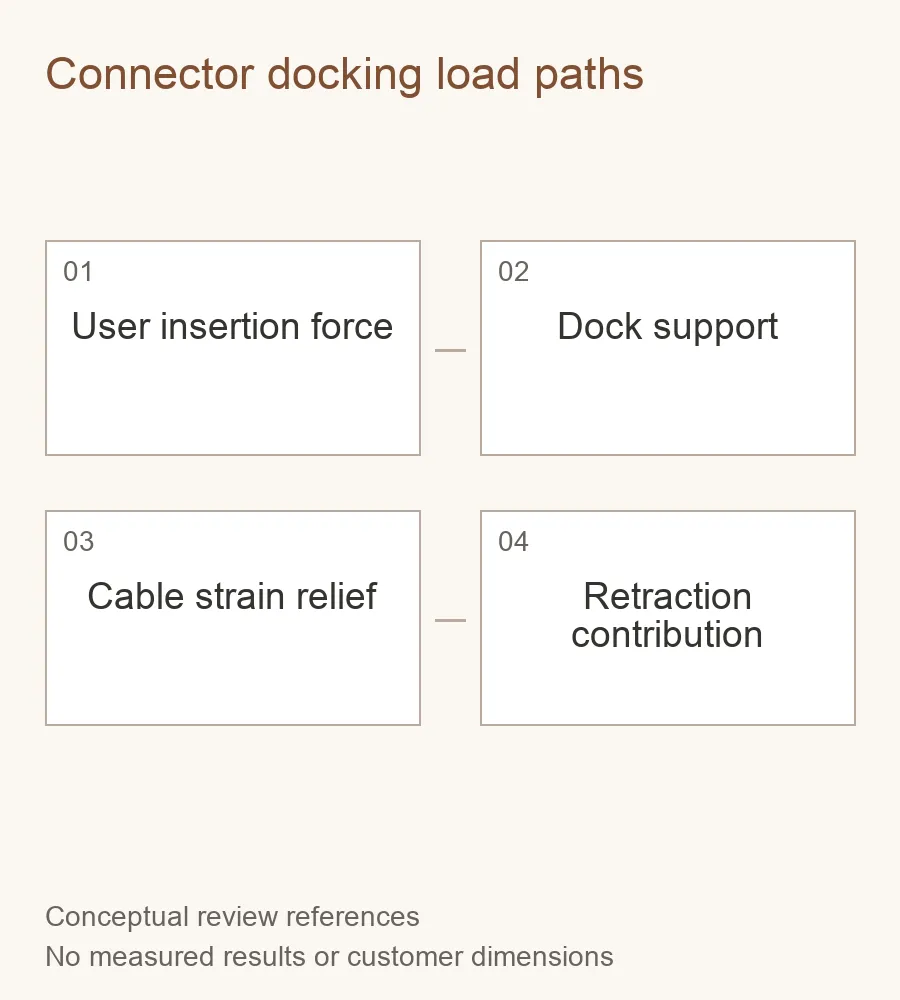
At the end of retraction, does the connector enter a guide, meet a stop or remain in the user's hand? Define that sequence. A collision with the dock is not equivalent to controlled connector insertion.
Check cable strain relief while the connector is inserted, withdrawn and parked. These actions can load the cable in different directions even when the reel remains at nearly the same position.
A useful assembly test records the docking action separately from cable pull and return. That allows spring changes to be evaluated without confusing them with changes in connector alignment, support stiffness or the user's insertion method.
For the broader background, read Cable Reel Return with a Suspended Connector Load.
Explore related spring information or discuss this mechanism with a non-confidential description.